Tools · Storage
Redis for AI Agent Memory
Redis functions as agent memory through sub-millisecond reads and writes, native vector search, and built-in expiration, and the open-source repository that ranks for this topic is, by the vendor’s own README, a superseded research prototype rather than the current product. Knowing that distinction matters before adopting anything you find under this name.
Four decisions
The premise
Why does an agent need memory at all, concretely?
Without it, every interaction starts from zero: preferences get re-asked, past mistakes repeat, and details the user already provided vanish. A travel-planning agent that forgot a user’s stated preference for direct flights, or their passport details from a previous booking, would produce exactly the repetitive, inconsistent experience memory exists to prevent.
Memory is on the hot path of every agent turn, which is precisely why the backend holding it matters as much as the design of the memory system itself. Reading and writing memory happens on every reasoning step, and slow retrieval either degrades the user experience directly or forces the agent’s design to compromise elsewhere to compensate. Redis is worth examining specifically because it enters this problem from an unusual angle: not as a new memory-specific product, but as an existing, extremely fast, general-purpose data platform being pointed at a new job.
That angle raises a question worth settling before anything else: the natural search for “Redis agent memory” surfaces an open-source repository first, and that repository is not what it first appears to be. Is the open-source Redis Agent Memory Server the current product?
A distinction worth knowing
Is the open-source Redis Agent Memory Server the current product?
No, by the repository’s own description. It is labelled V0, described as “the research foundation and architectural starting point” for a newer, managed offering, and stated directly as “not the current supported production path.” This is stated in the repository’s own documentation, not inferred from indirect evidence.
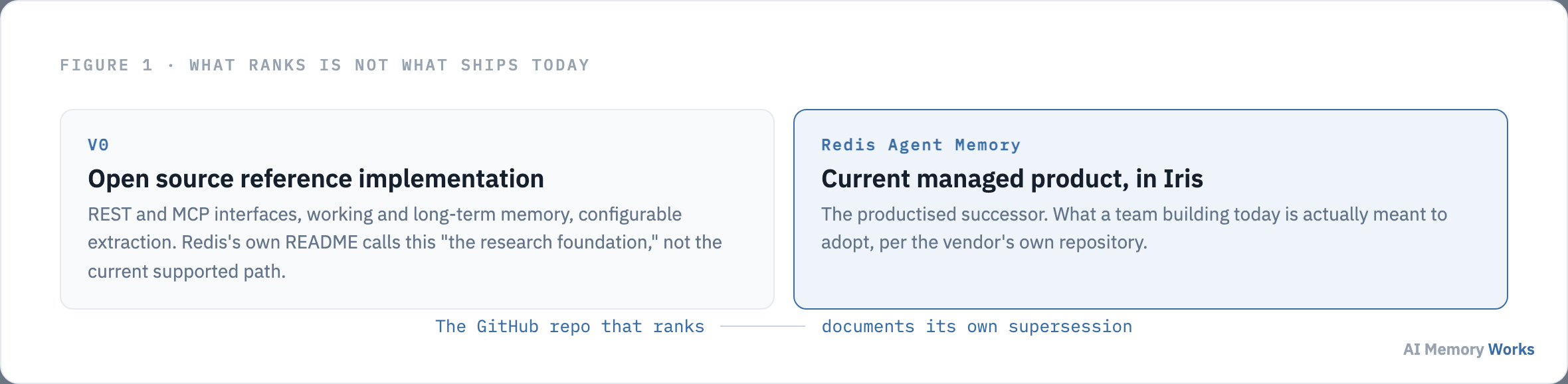
V0 is a genuine, working reference implementation: REST and MCP interfaces, working and long-term memory, configurable extraction strategies, Redis-backed semantic search. It remains useful as a way to see the underlying patterns in code, and its source is still browsable and runnable. What it is not, by the vendor’s own account, is the path a team should build production infrastructure on top of today.
The current path is Redis Agent Memory as a component of Redis Iris, described as a real-time context engine connecting memory, live business data and retrieval in one place. This distinction matters in practice: a team that finds the open-source repository through search, builds against it, and later discovers it has been superseded has taken on a migration it did not need to plan for. Checking a project’s own README for exactly this kind of status note, rather than assuming a starred repository is the current offering, is a habit worth having whenever adopting any open-source tool.
Whichever path is used, the underlying architectural questions are the same, and Redis’s own guidance frames them clearly: what four decisions actually shape a Redis-backed memory architecture?
The framework
What four decisions actually shape a Redis-backed memory architecture?
What to store, how to store it, how to retrieve it, and when to forget it. This is a genuinely useful way to organise the design work, because each of the four is a decision with real alternatives rather than a box to check.
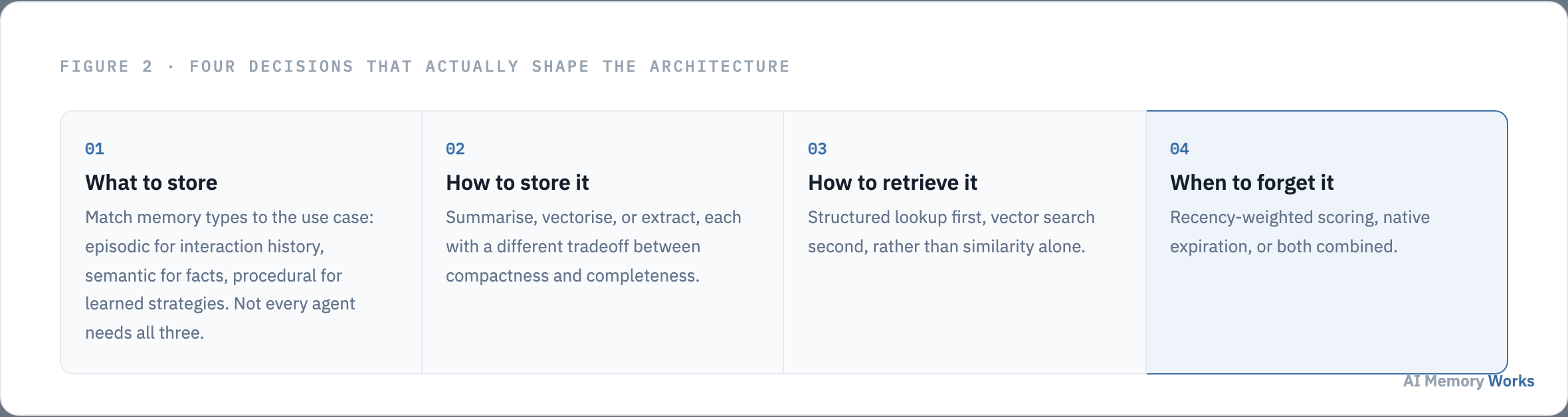
What to store starts from matching memory types to the use case rather than implementing every category on principle: a customer support agent needs episodic memory for ticket history, a product recommendation agent needs semantic memory for specifications and relationships, a coding assistant needs procedural memory for debugging strategies it has learned. Adding types the use case does not need is complexity with no return, a point this site makes generally on types of AI agent memory.
How to store it is the storage-format decision, covered next. How to retrieve it and when to forget it are covered further down. What ties all four together is a warning worth stating plainly: these decisions surface as real problems during development, not during planning, and teams that skip designing them up front tend to discover the gaps under production load rather than on a whiteboard.
The second decision, how to actually store a memory once you have decided it is worth keeping, has three named approaches with genuinely different costs: how should memories actually be stored: summarised, vectorised, or extracted?
Storage format
How should memories actually be stored: summarised, vectorised, or extracted?
Three distinct techniques, each trading away something different, and most production agents combine more than one rather than picking a single approach. Treating these as interchangeable synonyms for “process the conversation” hides the actual tradeoff each one makes.
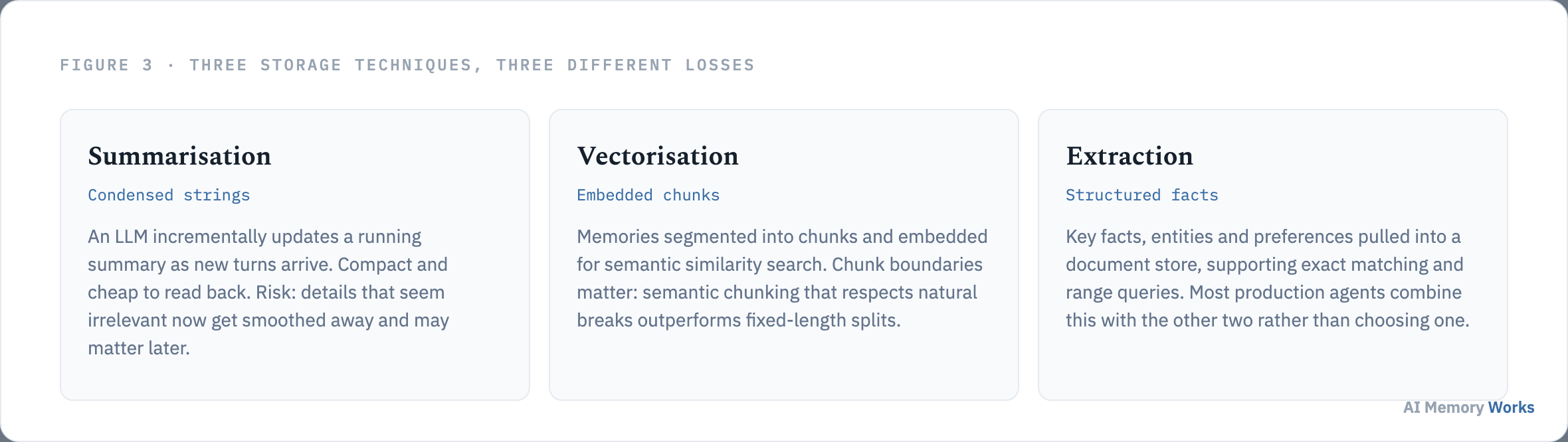
Summarisation uses a model to incrementally condense a conversation into a running summary, stored as a plain string. It is compact and cheap to read back, and it risks losing a detail that seemed irrelevant when the summary was written but matters later, since a summary by nature keeps the gist and drops specifics. Vectorisation segments memories into chunks and embeds them for retrieval by semantic similarity; the boundary chosen for each chunk matters more than it first appears, since chunking that respects the natural structure of the content tends to outperform mechanically splitting at a fixed length. Extraction pulls specific facts, entities and preferences into a structured record, stored in a document format that supports exact matching and range queries rather than only similarity search, at the cost of the extraction step itself needing to correctly judge what is worth keeping, covered in depth on writing memories.
None of the three is strictly better than the others; each answers a different question well. A summary answers “what has this conversation been about.” A vector search answers “what have we discussed that resembles this.” An extracted fact answers “what specifically is true about this user, exactly.” Most working systems need answers to all three questions at different moments, which is why combining techniques is the norm rather than the exception in practice.
Storage format determines what exists to be found. Retrieval determines how it actually gets found at the moment a query arrives, and here the guidance is specific about order rather than just naming two signals: how should memories actually be retrieved?
Retrieval order
How should memories actually be retrieved?
Structured lookup first, vector search second, as a narrowing sequence rather than two signals merged in parallel. That specific ordering is a more precise claim than “combine vector and keyword search,” and it is worth stating exactly as such.
An exact match on a known field, a user identifier, a stated preference, a timestamp range, runs first and narrows the candidate set to what could possibly be relevant before anything is ranked by meaning. Vector search then applies within that narrowed set, embedding the current context and finding the closest matches by similarity. Running the structured filter first rather than the vector search first means the similarity computation only ever runs over records that already passed a hard, correctness-relevant constraint, such as belonging to the right user, which is the scoping-as-boundary argument this site makes generally on vector databases for agent memory.
More sophisticated designs go further and give the agent itself the choice of when to consult long-term memory at all, generating an explicit retrieval query via a function call rather than always searching automatically on every turn. The pragmatic starting point for most teams is simpler: begin with the structured-then-vector sequence above, and add that further sophistication only once retrieval quality becomes an actual, measured bottleneck rather than a theoretical one.
Storing and retrieving memories correctly still leaves one problem unaddressed: what happens to a store that only ever grows. How does old memory get forgotten?
Decay
How does old memory get forgotten?
Two mechanisms, usable separately or together: weighting recent memories higher at retrieval time using a timestamp, or letting records expire automatically through native eviction policies. Without either, a growing store pollutes its own retrieval quality as irrelevant older records accumulate.
Recency weighting adds a timestamp as metadata on each record and factors it into the ranking at read time, so an older memory can still be retrieved when nothing more recent matches, but loses ground to a newer, equally relevant one. Native expiration takes a different approach entirely: records are set to expire and are removed by the store itself, with no ranking step involved, which is a capability a general-purpose data platform provides natively rather than something a memory system has to reimplement from scratch. Combining both, expiring genuinely stale records outright while recency-weighting everything that remains, covers more of the practical cases than either alone, and it mirrors the retire-versus-delete distinction covered more fully on forgetting and eviction.
All four architectural decisions assume the backend underneath them actually performs well enough for memory to sit safely on an agent’s hot path, which is where Redis’s own claims, and how carefully to read them, become relevant: what does Redis actually claim about latency, and how should you read it?
Reading the numbers
What does Redis actually claim about latency, and how should you read it?
Sub-250ms P95 query latency, a published vector-search benchmark, and one customer’s reported improvement, and each of the three should be read as coming from a different, specific source rather than as one unified, independently verified fact.
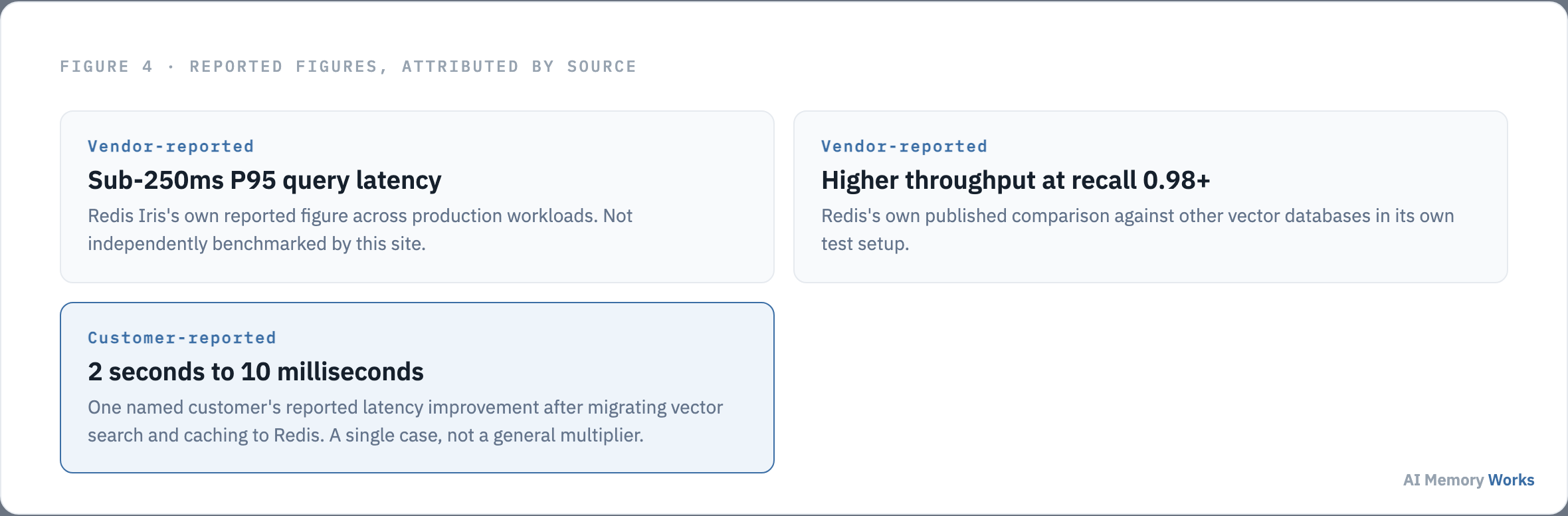
The sub-250ms P95 figure and the vector-search throughput comparison are both Redis’s own reported numbers, from its own published testing setup, describing its own product. That does not make them false; it means they should be read the way any vendor’s self-reported benchmark should, following the same standard this site applies on the LongMemEval benchmark: attributed by source, understood as one methodology rather than a universal truth, and not assumed to transfer unchanged to a different workload or scale.
The customer figure, one company’s reported drop from two seconds to ten milliseconds after migrating its vector search and caching to Redis, is a single named case, not a general multiplier every team should expect. It demonstrates that a large improvement is possible in the right circumstances; it says nothing about what an unrelated workload, on different data at a different scale, would see.
What none of these figures need independent verification to establish is the underlying architectural reason Redis performs well here at all: an in-memory data platform with native vector indexing genuinely removes network hops and disk-latency steps that a assembled-from-parts stack would otherwise pay for on every single memory read. The magnitude of the benefit is workload-specific; the mechanism producing it is not in question.
With the architecture, the decisions, and the performance claims all on the table, the remaining question is whether this backend is the right one for a specific team: is Redis the right backend for your agent’s memory?
The decision
Is Redis the right backend for your agent’s memory?
Strongly, when low latency on the hot path matters more than anything else and the team is prepared to design the four decisions above deliberately; less clearly when the priority is a memory pipeline that requires little design work at all.
Redis brings genuine architectural advantages: an in-memory core built for exactly the kind of read-heavy, latency-sensitive access pattern agent memory produces, native vector search alongside more familiar data structures, integrations across the popular agent frameworks, and expiration built into the platform rather than bolted on. What it does not provide out of the box is the extraction, reconciliation and supersession logic that decides what is worth storing and resolves contradictions between memories; those remain design and implementation work on top of the platform, following the storage-and-retrieval guidance above.
For a team that wants those decisions made for them rather than designed from scratch, a managed memory layer such as Engram is worth weighing directly against building on Redis yourself, since it takes on the extraction and reconciliation work as a service rather than leaving it as an architectural decision for the team. Which is the better fit depends on whether the team’s priority is control over every layer at the lowest possible latency, or a solved pipeline they can adopt without building the four decisions above themselves; the broader landscape of that choice is on storage backends and memory tools.
FAQ
Frequently asked questions
The adoption questions that follow once the architecture is understood.
Should I build on the open-source Redis Agent Memory Server (V0) today?
Redis's own repository describes V0 as the research foundation and architectural starting point, not the current supported production path. A team starting fresh should evaluate the managed Redis Agent Memory product in Iris rather than building new infrastructure on the superseded open-source layer.
Does Redis replace a vector database for agent memory?
No, Redis is the storage and retrieval layer, not a replacement for the decisions covered on choosing a vector database. Redis supports vector search alongside structured lookups, but what to store and how to chunk it are separate decisions this page covers.
Is Redis's sub-250ms P95 latency figure independently verified?
No. It is Redis's own reported figure from Iris across its production workloads, carried here attributed to the vendor rather than as an independently confirmed benchmark. Treat it as a claim to test against your own workload, not a guarantee.
What is the difference between recency-weighted decay and Redis's native expiration?
Recency-weighted scoring adjusts how memories rank in retrieval as they age, while native TTL-based expiration removes keys outright once a threshold passes. Most production setups combine both rather than relying on either alone.
When does a managed option like Engram make more sense than operating Redis directly?
When a team wants memory extraction, scoring and retrieval handled as a pipeline rather than assembled from Redis primitives themselves. Operating Redis directly gives more control over storage and retrieval mechanics; a managed layer trades that control for less infrastructure to run.
Does hybrid retrieval in Redis mean running vector and keyword search in parallel?
Not in the ordering described in Redis's own material: structured lookups on exact identifiers or timestamps run first to narrow the set, with vector search applied second for semantic ranking within that narrowed result, rather than merging two parallel scores.
Continue exploring
How do the storage tiers compare generally?
Cache, relational and vector backends for memory.
Read →What does a managed pipeline look like?
Extraction and reconciliation without building it yourself.
Read →How does structured and vector search actually combine?
Fusion mechanics beyond the ordering described here.
Read →