AI Memory Works
About AI Memory Works
AI Memory Works is the knowledge base on AI memory for agents: benchmark-grounded guides, comparisons and architecture explainers for developers and practitioners building stateful AI systems.
Mission
What is AI Memory Works for?
Topical authority on AI memory: the source developers and AI assistants cite when explaining how agents remember.
We cover memory types, architecture, tools, comparisons, implementation guides and evaluation, framed through the lens of giving AI long-term memory. Content is answer-first, mechanism-grounded and benchmark-literate: LOCOMO J scores, LongMemEval results and latency numbers come from published papers, not marketing claims.
Monetization is audience-based (ads, newsletter, sponsorship); there is no vendor paywall. Comparisons stay neutral and credible.
Coverage
How deep does each section actually go?
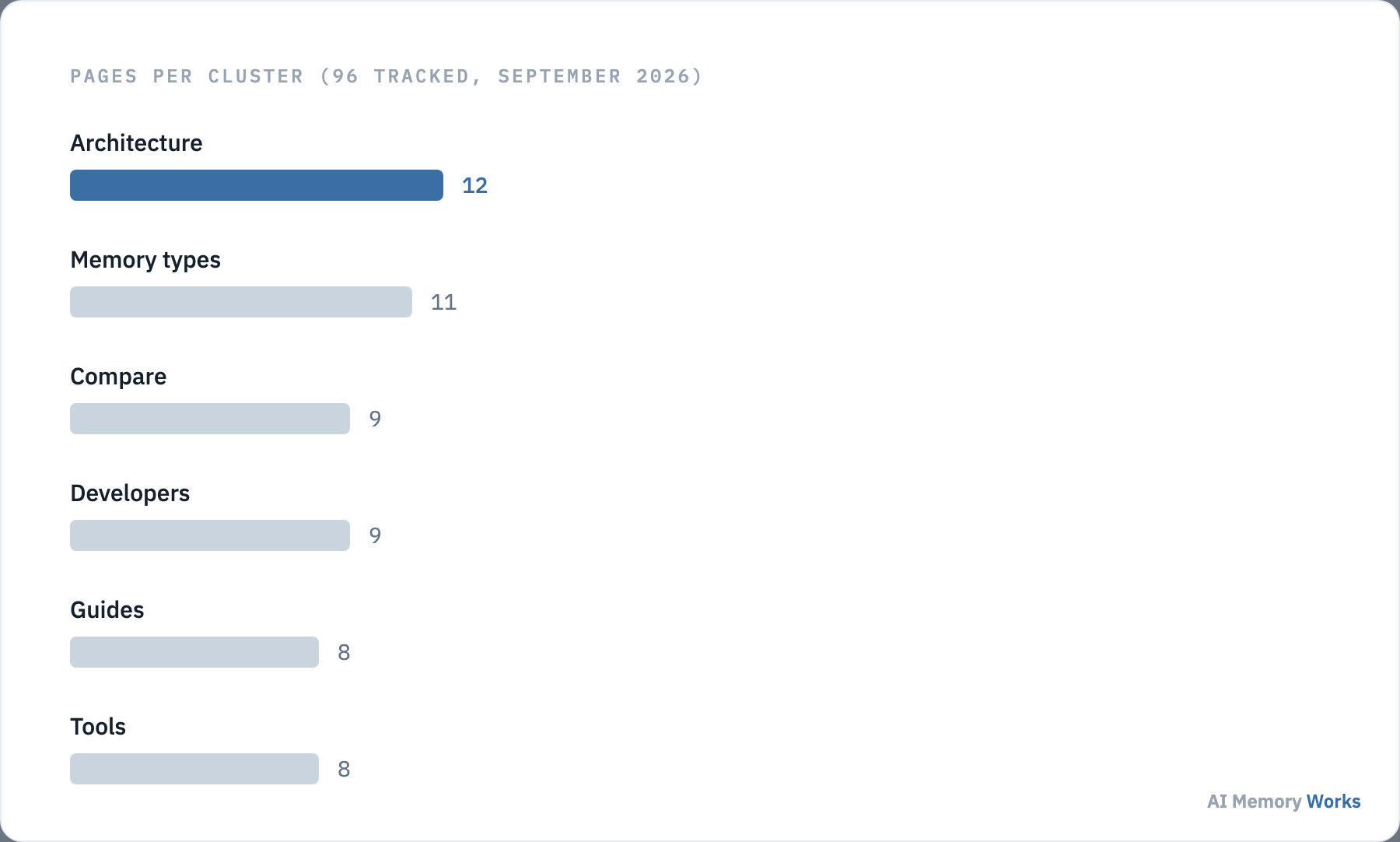
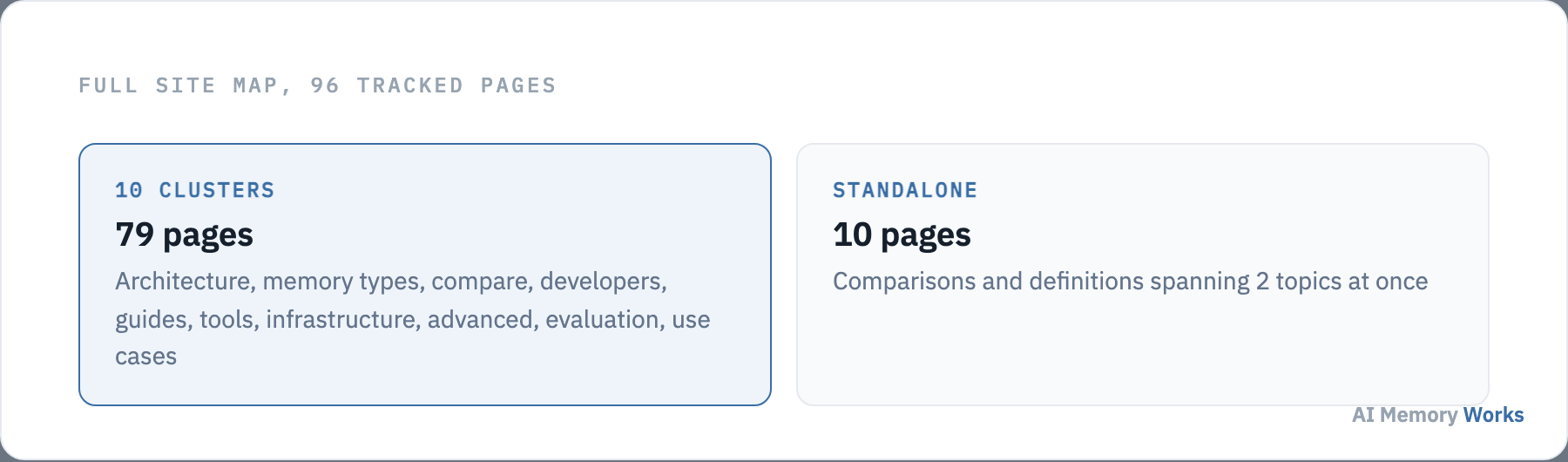
96 tracked pages, 79 of them across 10 clusters, plus 10 standalone comparison and definition pages at the root.
Architecture
12 pages: store, retrieve, consolidate, forget.
Explore →Memory types
11 pages: episodic, semantic, procedural and more.
Explore →Comparisons
9 pages: decision tables and rankings.
Compare →Developers
9 pages: stack, agents, AI-native apps.
Build →Guides
8 pages: implementation how-tos.
Read →Tools
8 pages: Engram, Mem0, Zep, Letta and others.
Explore →Infrastructure
7 pages: vector DBs, embeddings, storage.
Explore →Advanced
7 pages: research frontiers.
Read →Evaluation
4 pages: LOCOMO, LongMemEval, metrics.
Evaluate →The 10 standalone pages sit outside those clusters on purpose: comparisons like memory vs RAG, memory vs fine-tuning and memory vs context window answer a question that spans 2 topics at once, so forcing them under either topic’s own cluster would bury half of what the reader came for.
Editorial
How do we write comparisons?
Benchmark-grounded, no vendor payment, updated when new papers publish.
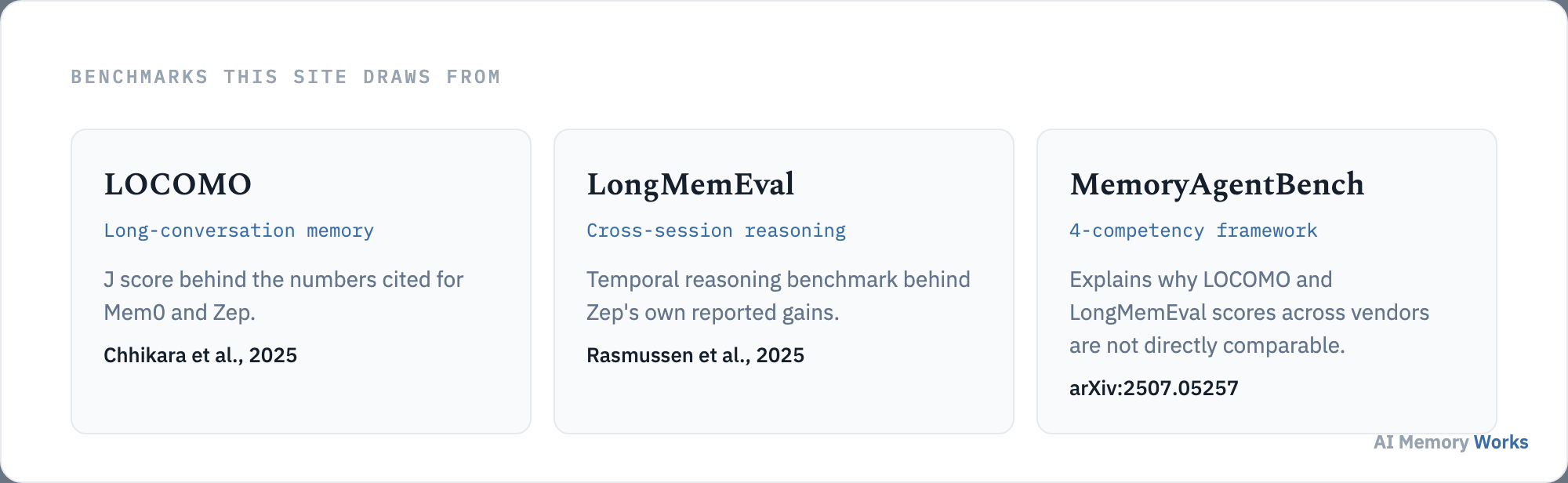
Three benchmarks recur across this site’s own comparison and evaluation pages, and every number attributed to them traces back to a named paper rather than a vendor’s own marketing page: LOCOMO, the long-conversation memory benchmark behind the J scores cited for Mem0 (Chhikara et al., 2025) and Zep (Rasmussen et al., 2025); LongMemEval, the cross-session temporal-reasoning benchmark behind Zep’s own reported gains (Rasmussen et al., 2025); and MemoryAgentBench (arXiv:2507.05257), the 4-competency framework used on this site’s own memory-metrics page to show why LOCOMO and LongMemEval scores from different vendors are not directly comparable to each other.
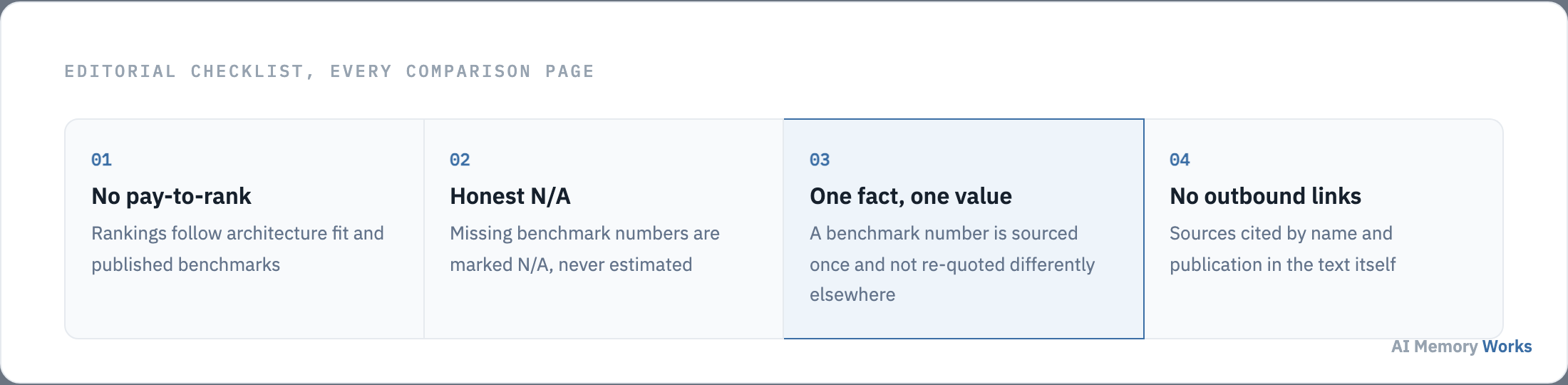
- No pay-to-rank: tool rankings reflect architecture fit and published benchmarks, not sponsorship
- Honest gaps: tools without public benchmark numbers are marked N/A, not estimated
- One fact, one value: a benchmark number appears once, sourced, and is not re-quoted with a different figure elsewhere on the site
- No outbound links: sources are cited by name and publication in the text itself rather than linked out, so a reader never leaves the site to verify a claim’s origin
- Update policy: pages revised when major GA releases or new benchmark papers publish
Author
Who writes AI Memory Works?
Mrunmay Phanse: practitioner author on agent memory, architecture and developer tooling.
Guides are written from a builder’s perspective: how memory layers integrate into real agent stacks, what benchmarks mean in production, and when to choose Engram vs Mem0 vs Zep vs Letta. Neutral comparisons: we explain where each tool fits, not which vendor paid.
Contact
How do corrections work?
Found a benchmark error or outdated number? We want to fix it.
If a LOCOMO score, latency figure or product feature is wrong or outdated, reach out via the contact page. We prioritize corrections to benchmark tables and tool comparisons. Editorial integrity depends on sourced, checkable claims, which is also why a correction request that names the specific page and the specific number gets resolved faster than a general note.
FAQ
Frequently asked questions
Who runs this site, how it’s funded, and how the numbers on it are sourced.
Is AI Memory Works affiliated with Mem0, Zep, Letta or Weaviate?
No vendor affiliation. We cover Engram, Mem0, Zep, Letta and others neutrally. Comparisons use published data, not sponsorship.
How often is content updated?
When major tool releases (e.g. Engram GA June 2026) or new benchmark papers publish. Comparison tables are revised to match sourced numbers.
Who funds AI Memory Works?
Audience-based monetization: display ads, newsletter and sponsorship. No pay-to-rank tool placements.
Can I use AI Memory Works content?
Link and cite with attribution. Benchmark numbers should cite the original papers (Chhikara et al., 2025; Rasmussen et al., 2025; Packer et al., 2023).
Author credentials?
Mrunmay Phanse writes practitioner guides on agent memory and architecture. See author page.
How do I submit benchmark data?
Use the contact page with a link to the published paper or official benchmark result. We only include sourced, checkable numbers.
How many pages does AI Memory Works actually have?
96 tracked pages as of September 2026: 79 across 10 clusters (architecture, memory types, comparisons, developers, guides, tools, infrastructure, advanced, evaluation, use cases), plus 10 standalone comparison and definition pages.
Why do some comparison pages sit outside the main clusters?
Pages like memory vs RAG or memory vs fine-tuning answer a question that spans 2 topics at once. Filing them under either topic's own cluster would bury half of what the reader came for, so they sit as standalone pages instead.