Compare · Mem0 alternatives
Top Mem0 Alternatives for AI Agent Memory
The best Mem0 alternatives for AI agent memory are Engram (Weaviate), Zep, Letta (MemGPT), LangMem, Cognee and Hindsight: compared on architecture, memory ops, licensing, latency and fit.
Evaluation criteria
Baseline
What is Mem0?
Mem0 is a memory layer for AI agents: a managed API plus open-source SDK for per-user personalization.
Core pipeline: (1) extract salient facts from conversation; (2) embed and store in a vector backend; (3) retrieve relevant memories on future turns filtered by user or agent ID; (4) update per-user memory over time. Framework-agnostic “memory as a service,” with roughly 48,000 GitHub stars, the largest community among agent memory frameworks.
Mechanism
How does Mem0 agent memory actually work?
Five steps, from a raw conversation turn to an updated per-user memory record.
Input
Conversation turn or explicit memory.add()
Extract
LLM or heuristic fact extraction
Store
Vector embedding, plus optional graph
Retrieve
Semantic search by user ID
Update
Merge or replace on new info
Mem0 primarily implements long-term semantic and episodic user memory. It does not natively optimize bi-temporal graph queries (see Zep) or virtual-context paging (see Letta). → Long-term memory
Why switch
Why look for Mem0 alternatives at all?
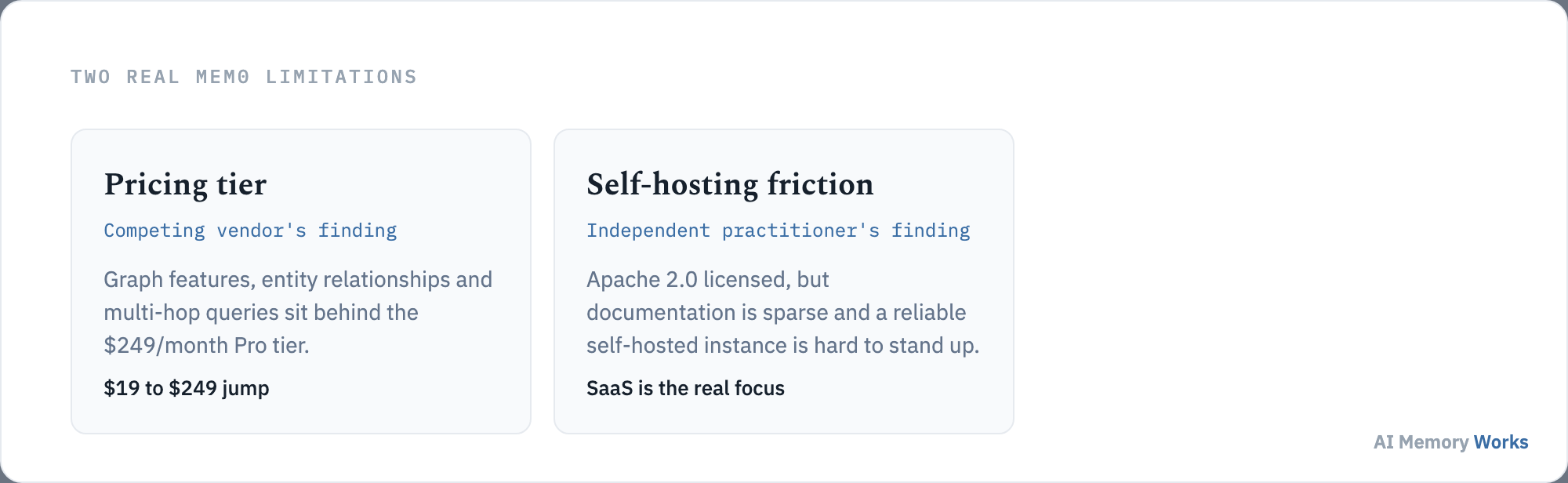
Two real limitations, named independently by a competing vendor and by a practitioner with no product to sell.
The most commonly cited reason is pricing architecture. Mem0’s graph features (entity relationships, multi-hop queries, structured knowledge) sit behind the $249/month Pro tier; the $19/month Standard tier gives vector search only, and that jump is steep for teams who haven’t yet tested how much value graph retrieval would actually add. A second, more practical limitation shows up specifically around self-hosting: Mem0’s core is Apache 2.0 licensed, but according to an independent practitioner’s own hands-on account, documentation for self-hosting is sparse, and community reports suggest getting a reliable self-hosted instance running is genuinely difficult, since the company’s own focus is clearly the SaaS product. Neither of these findings disputes that Mem0’s managed platform itself is stable and fast to integrate; both point at the same underlying pattern, that self-hosting and the deeper graph features are secondary priorities behind the hosted API.
- Weaviate-native, unified vector and memory: Engram
- Temporal or graph memory with validity windows: Zep
- Unbounded conversation via paging: Letta
- LangGraph-native checkpointer: LangMem
- Document-heavy evolving KG: Cognee
- Multi-strategy retrieval without a Pro-tier paywall: Hindsight
- Self-host without a managed API: Redis or DIY
Mem0 is popular but not the only production-ready option; architecture fit beats brand.
Side by side
How do the Mem0 alternatives compare, side by side?
Last updated: September 2026. Architecture, ops and fit at a glance.
| Tool | Architecture | Memory ops | OSS | Managed | Best for |
|---|---|---|---|---|---|
| Engram | Vector-native layer | Async extract, transform, commit | ✓ | ✓ | Weaviate AI-native apps |
| Zep | Temporal KG (Graphiti) | Full, temporal invalidation | ✓ | ✓ | Changing facts, CRM timelines |
| Hindsight | 4-retriever hybrid | Extract, reflect, rerank | ✓ (MIT) | ✓ | Graph/temporal without a paywall |
| Letta | Virtual paging | Page in/out, tiered store | ✓ | ✓ | Very long conversations |
| LangMem | LangGraph store | Extract, store, retrieve | ✓ | N/A | LangGraph agent teams |
| Cognee | Evolving KG | Graph write, query | ✓ | N/A | Document-heavy knowledge agents |
| Supermemory | Memory + RAG bundled | API CRUD + MCP | N/A | ✓ | Fast prototyping, generous free tier |
| Redis/DIY | Custom | DIY (you build logic) | ✓ | Self | Compliance, custom logic |
Profiles
What does each alternative actually offer?
Real numbers where they exist, not just each tool’s own pitch.
Engram (Weaviate)
Vector-native dynamic memory layer
Strengths: unified vector DB and memory, per-interaction updates, Weaviate ecosystem, no separate memory store.
Weaknesses vs Mem0: Weaviate platform tie-in, less portable API.
Best for: AI-native apps already on Weaviate.
Zep
Temporal knowledge graph (Graphiti)
Strengths: time-changing facts, relationship traversal, conflict resolution, bi-temporal validity.
Weaknesses vs Mem0: heavier setup, graph ops, steeper learning curve, self-hostable Community Edition now discontinued.
Best for: CRM timelines, policy versioning, evolving entity relationships.
Hindsight
4-retriever hybrid memory engine
Strengths: semantic search, BM25 keyword matching, entity-graph traversal and temporal reasoning merged by a cross-encoder rerank; MIT license with graph and temporal features included at every tier, including self-hosted; entity resolution across memories (mapping “Alice,” her email and “the account owner” to one node).
Weaknesses vs Mem0: a newer project (reported at roughly 4,000 GitHub stars, launched 2025, versus Mem0’s ~48,000), a smaller library of tutorials and examples.
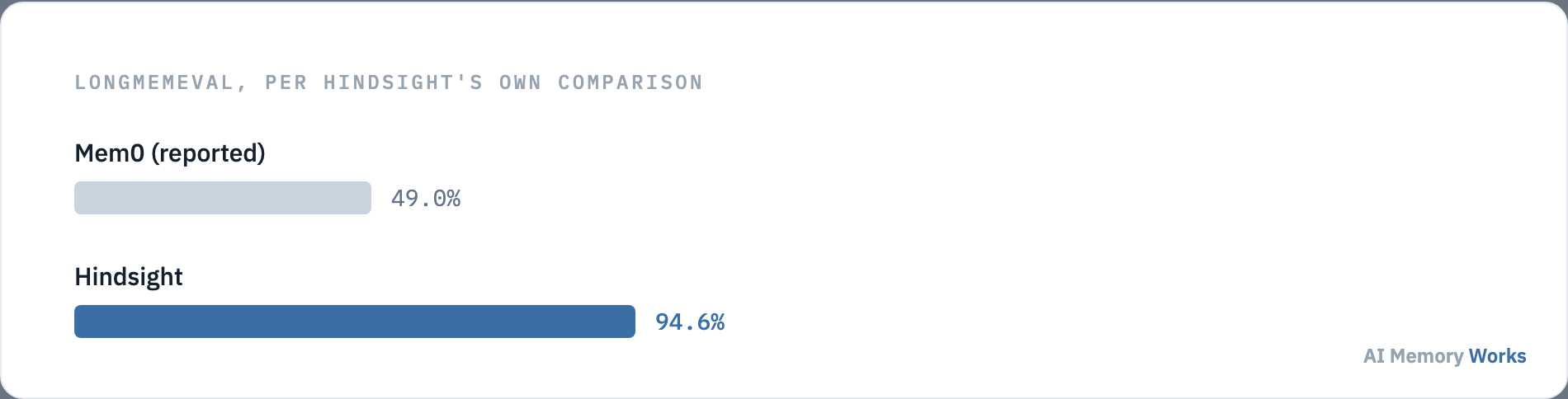
Note: Hindsight’s own vendor reports 94.6% on LongMemEval against a reported 49.0% for Mem0, describing the latter as an independent evaluation; treat this as that vendor’s own comparison, not a result this site has independently reproduced.
Best for: teams that want graph and temporal retrieval without a Pro-tier paywall.
Letta (MemGPT)
Virtual context / memory paging
Strengths: unbounded effective context, tiered memory hierarchy, agent-controlled recall, MemGPT research lineage, a genuinely active open-source community.
Weaknesses vs Mem0: not a drop-in personalization API, more agent-framework coupling; 1 independent practitioner review found it not yet production-ready for mission-critical use, with effectiveness tied closely to the underlying LLM’s own reasoning quality.
Best for: very long multi-session conversations, or teams comfortable growing alongside an actively evolving open-source project.
LangMem
LangGraph memory store + checkpointer
Strengths: native LangChain and LangGraph integration, checkpoint patterns.
Weaknesses vs Mem0: ecosystem lock-in.
Best for: LangGraph agent teams.
Cognee
Evolving knowledge graph from documents
Strengths: structured knowledge from ingest, graph semantics.
Weaknesses vs Mem0: less conversational user-memory focus.
Best for: document-heavy knowledge agents.
Supermemory
Memory and RAG bundled
Strengths: a more generous free tier than Mem0’s 10,000-memory limit, memory and RAG consolidated into 1 API, simple integration for prototyping.
Weaknesses vs Mem0: closed source with no self-hosting outside enterprise plans, limited graph and temporal depth, less architectural transparency since the retrieval pipeline can’t be inspected.
Best for: fast prototyping without deep graph or temporal requirements.
Build your own (Redis / pgvector)
DIY custom pipeline
Custom extraction, embed, retrieve and user scoping. DIY wins: data residency, custom logic, cost at scale. Mem0 wins: extraction pipeline and managed API out of the box.
Storage backends →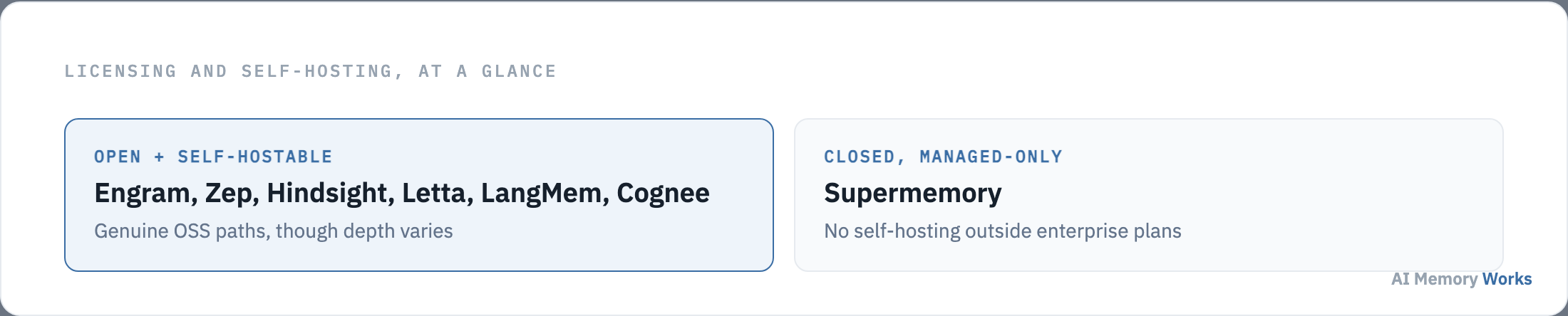
Decision
Which one should you actually pick?
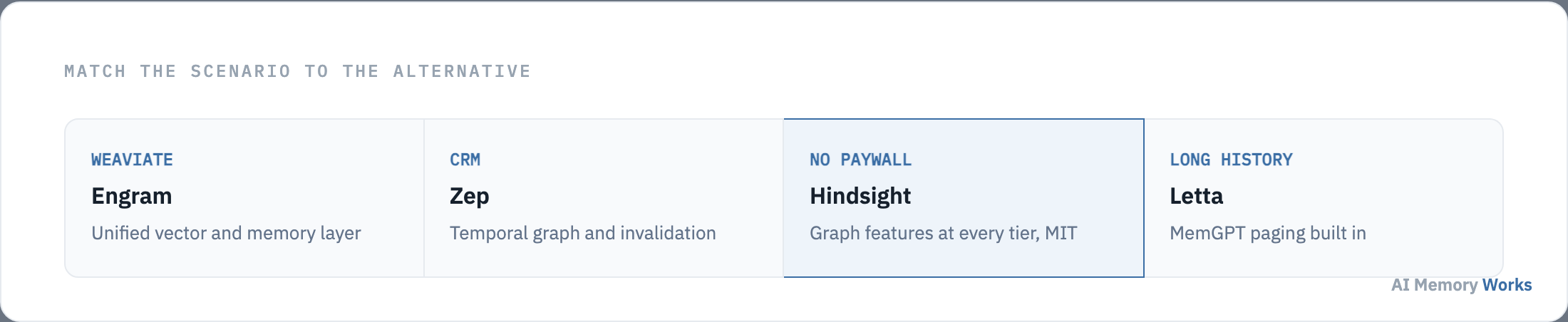
Match the scenario, not the brand recognition.
| Scenario | Pick | Why |
|---|---|---|
| Weaviate AI-native app | Engram | Unified vector and memory layer |
| Per-user chat personalization | Engram or Mem0 | Managed API, fast POC |
| CRM with changing facts | Zep | Temporal graph and invalidation |
| Graph features without a Pro-tier paywall | Hindsight | All features at every tier, MIT |
| 100K+ token conversation history | Letta | MemGPT paging built in |
| LangGraph agent | LangMem | Native checkpointer integration |
| Document KB agent | Cognee | Evolving KG from ingest |
| Self-hosted compliance | Redis/DIY | Full infra control |
Stay
When should you stick with Mem0?
Five signals the managed platform’s own tradeoffs are the right fit for you.
- Fast personalization POC
- Framework-agnostic API needed
- Per-user memory without graph engineering
- Team wants a managed extraction pipeline
- Retrieval quality acceptable on your own eval
Migrate
How do you migrate away from Mem0?
The same 6-step sequence regardless of which alternative you’re moving to.
- Export memories via API or SDK
- Map schema to the target (vectors to graph, tiers or collections)
- Re-embed if the target uses a different model
- Run a retrieval POC on your own data
- Dual-write cutover
- Validate retrieval per user ID
FAQ
Frequently asked questions
Mem0’s real limitations, how the alternatives compare, and how to migrate.
What is the best alternative to Mem0?
Depends on need: Engram (Weaviate) for vector-native stacks, Zep for temporal graphs, Letta for long conversations, LangMem for LangGraph, Hindsight for graph features without a Pro-tier paywall. Mem0 itself is best for a fast personalization API. See comparison table above.
Is Zep better than Mem0?
Zep is better when facts change over time and you need relationship traversal: CRM timelines, policy versioning. Mem0 is simpler for per-user chat personalization. See Zep alternatives.
Is Letta the same as MemGPT?
Letta is the production framework implementing the MemGPT research paper (Packer et al., 2023): virtual context paging for unbounded conversations. See virtual context and MemGPT.
Is Engram a good Mem0 alternative?
Yes, if you're already on Weaviate. Engram provides vector-native dynamic memory on the same platform without a separate store. See Engram explained.
Can I use LangMem instead of Mem0?
Yes for LangGraph agents; LangMem provides native checkpointer and store integration. For framework-agnostic apps, Engram, Mem0 or Zep are more portable. See LangMem.
Is Mem0 open source?
Mem0 offers an open-source SDK plus a managed cloud API, though an independent practitioner review found self-hosting documentation sparse in practice. See Mem0 profile.
How does Mem0 pricing compare to alternatives?
Mem0 charges per API usage on managed cloud, with graph features gated behind a $249/month Pro tier. DIY (Redis/pgvector) can be cheaper at scale but you build extraction yourself. Hindsight includes graph features at every tier under an MIT license.
Should I use Mem0 if I already have RAG?
Yes. RAG and agent memory serve different purposes. RAG retrieves static docs; Mem0 stores dynamic per-user facts. Most production agents use both. See memory vs RAG.
Mem0 vs Redis for agent memory?
Mem0 includes a managed extraction and retrieval API. Redis requires you to build the full pipeline but gives full control and data residency. See storage backends.
Is Mem0 good for customer support bots?
Yes for per-user personalization and ticket context. If facts change frequently (policy updates, account status), compare Zep for temporal invalidation. See use cases hub.
Mem0 vs fine-tuning for personalization?
Mem0 handles dynamic per-user facts updated at runtime. Fine-tuning bakes static domain style into weights. Most agents use memory, not fine-tuning, for personalization. See memory vs fine-tuning.
How do I migrate off Mem0?
Export via API, map schema to the target store, re-embed if needed, run a LOCOMO/LongMemEval POC, dual-write during cutover. See migration section above and build long-term memory.
What is Hindsight, and how does it compare to Mem0?
Hindsight is a memory engine merging 4 retrieval strategies (semantic, keyword, graph, temporal) that includes graph and temporal features at every tier, including self-hosted, under an MIT license. Its own vendor reports a 94.6% LongMemEval score against a reported 49.0% for Mem0; treat that as the reporting vendor's own comparison.
What are Mem0's real limitations?
Graph features (entity relationships, multi-hop queries) are gated behind a $249/month Pro tier, and an independent practitioner review found self-hosting documentation sparse despite the Apache 2.0 license.