Memory Types · Sensory
Does Sensory Memory Actually Apply to AI Agents?
Less cleanly than the standard four-part human-memory taxonomy suggests: an ordinary text-based agent tokenizes raw input almost immediately with no attention-based filtering step at all, which makes “sensory memory” a weaker analogy than presented for most agents. The concept becomes genuinely real, not just an analogy, specifically for multimodal agents that buffer vision or audio before extraction, and knowing the difference changes where it’s actually worth spending design effort.
Input pipeline
The honest answer
Does sensory memory actually exist in most AI agents?
Only in a weak, structural sense, not the functional sense the human analogy implies. In humans, sensory memory holds a raw impression, a visual afterimage, an echo of a sound, just long enough for attention to decide what’s worth noticing before it fades within a fraction of a second. That decision, what’s worth attending to, is the actual mechanism, and it’s the part most AI agents don’t have.
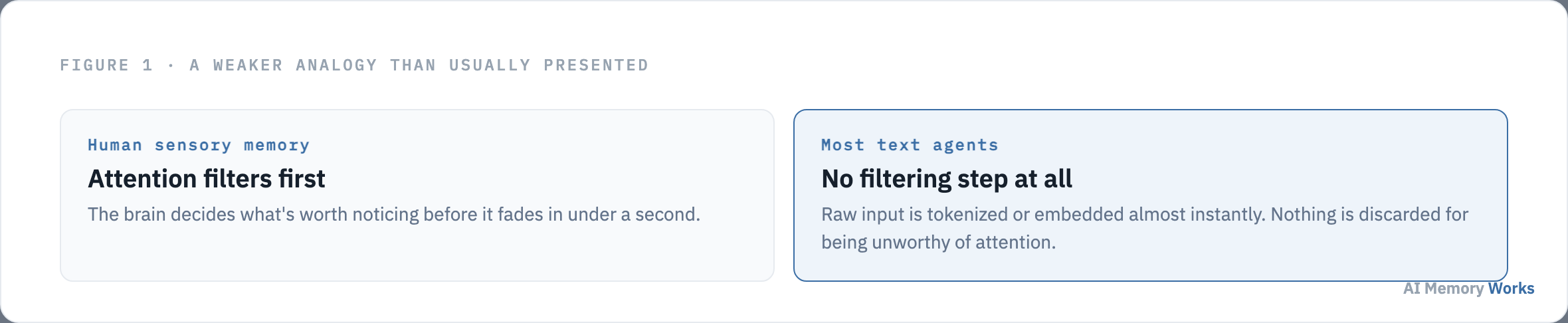
In an ordinary text-based agent, the closest equivalent to sensory memory is the raw input buffer holding text for the instant before it gets tokenized or embedded into a form the model can reason over. That buffer usually isn’t retained on purpose, and nothing gets discarded at that stage for being unworthy of attention, because there’s no equivalent step making that judgment. The system processes everything it receives; the actual filtering, deciding what’s worth keeping, happens later, at the point where the agent decides what to promote into short-term or long-term storage, not at the point of receiving raw input at all. Calling that instant a distinct “memory,” in the sense the term is used for working or long-term memory, overstates what’s actually happening.
The four-part human taxonomy, sensory memory, short-term or working memory, and long-term memory split into episodic, semantic and procedural sub-types, is genuinely useful for the last three categories, since each maps onto a real, distinct engineering decision in agent design: what stays in the context window for the current turn, what gets logged as a specific past event, what gets stored as a general fact, and what gets encoded as a learned behavior or rule. Sensory memory is the odd one out in that list, because human sensory memory names a specific cognitive mechanism, a brief, pre-attentive hold on raw perception, that most software systems simply don’t need to replicate to function. A calculator doesn’t need a sensory buffer to add two numbers, and neither does a model that converts a prompt straight into tokens; the mechanism sensory memory names exists in biology to solve a problem, limited attention bandwidth, that a tokenizer doesn’t actually have.
This is exactly why the concept doesn’t apply uniformly. There’s one category of agent where the analogy stops being a stretch and starts describing something real. Where does a real sensory buffer actually matter?
The real exception
Where does a real sensory buffer actually matter?
Multimodal agents, specifically ones handling vision, audio or OCR, genuinely hold raw signal briefly before extraction, which is an actual architectural stage rather than a borrowed metaphor. This is the one place the human analogy earns its keep.
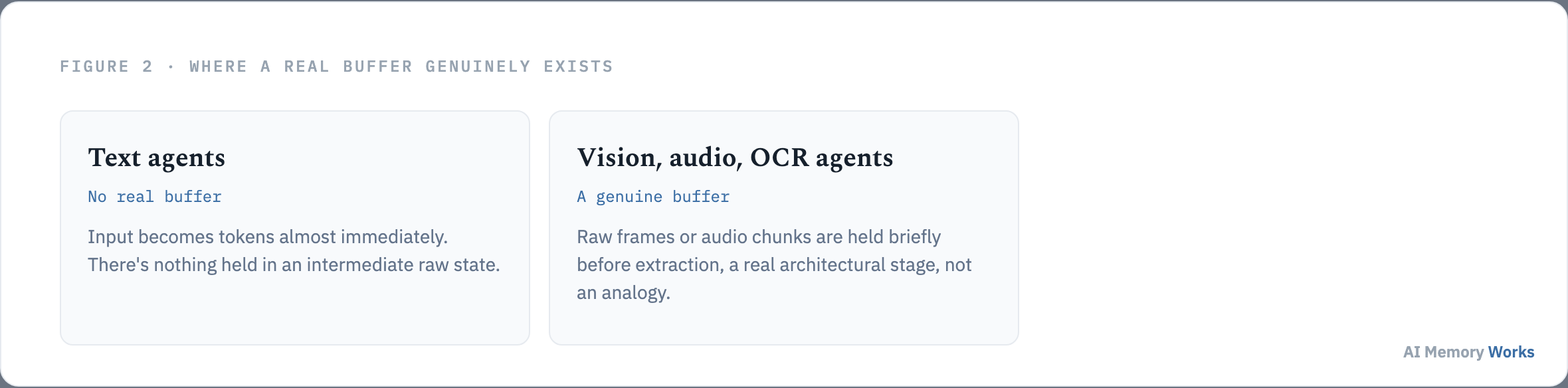
An OCR agent scanning a document, or a vision agent processing a video feed, or an audio agent transcribing speech, all hold a raw frame or chunk of signal for some real, non-trivial span before extracting anything usable from it, unlike a text agent’s near-instant tokenization. That gap is where a design decision actually exists: how long to hold the raw signal, what triggers extraction, and what gets discarded if extraction never happens in time. For a text-only agent, none of that decision exists to make, because there’s effectively no gap to design around.
The reason this gap opens up specifically for non-text modalities is bandwidth: an image frame or a second of audio carries far more raw data than a tokenizer needs to process at once, and extracting the useful signal, the text an OCR model reads off a scanned page, the objects a vision model identifies in a frame, the words a transcription model hears in an audio chunk, takes real processing time that text input doesn’t require. During that processing window, the raw signal has to sit somewhere, which is the closest functional match to biological sensory memory that agent architecture actually has: a brief hold on unprocessed input while something decides what’s actually worth extracting from it. A poorly designed buffer here has a real, visible failure mode too, dropped frames in a video agent, truncated audio in a transcription pipeline, that a text agent’s near-instant tokenization simply never produces.
A concrete instance makes this specific: a security-camera agent watching a live video feed can’t reasonably run full object detection on every single frame at full frame rate, so incoming frames sit in a short buffer while a lighter-weight process decides which ones are worth passing to the heavier detection model, discarding the rest. That discard decision, made before anything gets extracted or stored, is the one place in agent architecture that actually resembles the attention-based filtering biological sensory memory performs, rather than the pure pass-through a text agent’s tokenizer does.
Given how real this distinction is for multimodal agents and how thin it is for everything else, it’s worth asking why so much writing about agent memory skips the concept in either direction. Why do most agent-memory guides skip this concept entirely?
A telling absence
Why do most agent-memory guides skip this concept entirely?
Because working memory and long-term memory carry nearly all the practical design weight for the text-based agents most guides are written about, and sensory memory doesn’t. Several otherwise-thorough treatments of agent memory types don’t mention it at all.
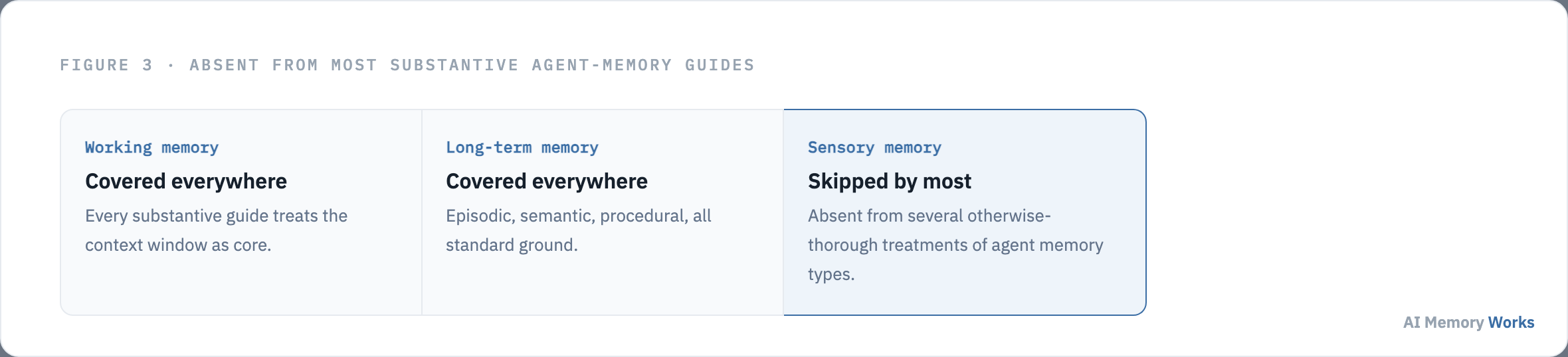
The pattern is consistent enough to be informative on its own: guides covering agent memory in real depth, including ones from major infrastructure vendors, routinely walk through working memory and the three long-term sub-types, episodic, semantic, procedural, in detail, without treating sensory memory as a fourth category worth designing for. That’s not an oversight; it’s an accurate reflection of where the actual engineering decisions live for the vast majority of agents built today, which are text-based and therefore have no real gap to fill at the sensory stage. The concept only earns space in a guide when the agent in question is multimodal, which most aren’t yet.
This is worth contrasting with how the concept gets treated where it does appear. Content that presents the four-part taxonomy as a universal, one-to-one mapping, matching a human cognitive stage to an AI system stage for every single category without exception, tends to come from more general, introductory material rather than from teams that have actually built production memory systems. The pattern holds across this specific research: sources that skip sensory memory tend to be the ones going deepest on how memory actually gets engineered, while sources that include it as a clean fourth category tend to be higher-level overviews aimed at readers new to the topic. Neither kind of source is wrong to write what it wrote; the overview material is simply optimizing for a complete-feeling taxonomy over an accurate one at this specific point.
None of this means the concept is worthless, only that it applies conditionally rather than universally. That leads to a practical question for anyone actually building something. Should you actually design for a sensory-memory stage?
The practical answer
Should you actually design for a sensory-memory stage?
Only if your agent handles vision, audio or another non-text modality. For a text-only agent, a dedicated sensory-memory stage adds architectural complexity with no corresponding benefit, since input becomes usable tokens almost immediately anyway.
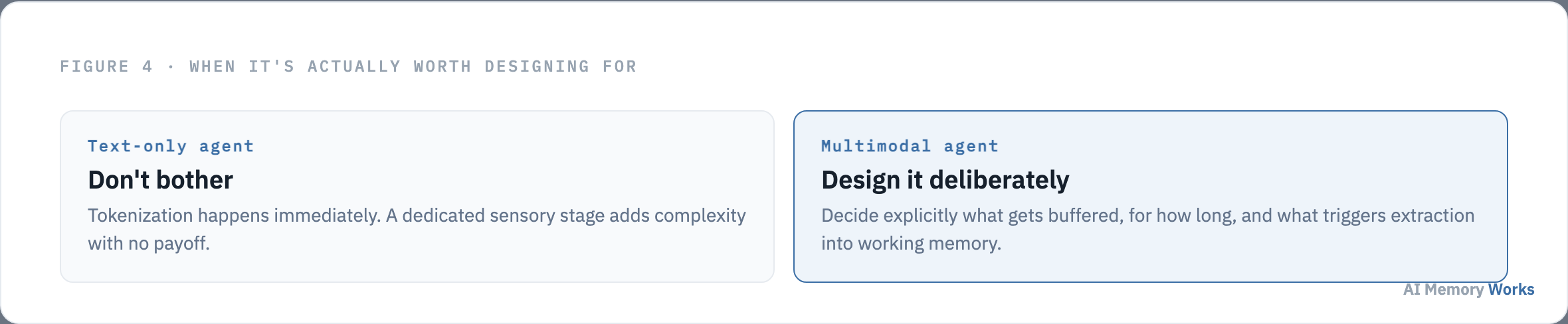
For a multimodal agent, the decisions worth making explicitly are how long raw signal gets buffered before it’s discarded or extracted, what determines when extraction actually fires, and what happens to a frame or audio chunk that arrives faster than the extraction step can process it. These are concrete engineering questions with real answers, not an exercise in matching a human cognitive category for its own sake. Getting the buffer duration wrong in either direction has a real cost: too short, and slow extraction drops legitimate input before it’s processed; too long, and the buffer itself becomes a growing memory and compute liability that scales with input volume rather than with anything actually useful being retained.
For a text-based agent, the more useful place to spend design effort is one stage later, on what actually gets promoted from the immediate input into working memory, covered in depth on short-term memory, and on how facts get extracted and validated before being written to durable storage, covered on writing memories. Treating the sensory stage as settled for a text agent, rather than a design problem to solve, isn’t a shortcut; it’s simply an accurate read of where the real engineering effort actually belongs for that kind of system. The general storage-tier hierarchy this stage feeds into, and how it relates to the organizational and technology-layer senses of “hierarchy” this site distinguishes elsewhere, is covered on memory hierarchy.
Video
The four types of memory, as most guides present them
A mainstream framing of the four-part taxonomy, worth watching alongside the more conditional case made above.
FAQ
Frequently asked questions
The practical questions that follow once the conditional case above is understood.
Do most AI agents actually need sensory memory?
No, not text-based agents. Multimodal agents handling vision, audio or OCR genuinely need a buffer to hold raw signal before extraction. A text agent's tokenization happens almost instantly, so there's no real gap to design a sensory stage around.
Is a sensory buffer the same thing as working memory?
No. A sensory buffer, where one genuinely exists, holds raw unprocessed signal for a brief span before extraction. Working memory holds already-processed, usable context, like the current conversation, and is covered in depth on short-term memory.
How do multimodal agents actually use sensory buffering?
Image frames, audio chunks or scanned pages queue briefly while a lighter process decides what's worth passing to a heavier extraction model, discarding or downsampling the rest, similar to a security camera agent that can't run full detection on every frame.
What happens if a sensory buffer is sized wrong?
Too small, and slow extraction drops legitimate input before it's processed. Too large, and the buffer itself becomes a growing memory and compute cost that scales with input volume rather than with anything useful being retained.
Is the human sensory memory analogy accurate for AI agents?
Only partially, and only for multimodal agents. Human sensory memory's defining feature is attention deciding what's worth noticing before it fades. Most text agents have no equivalent filtering step; they process everything they receive.
Should I build a dedicated sensory-memory module for a text-only chatbot?
No. Design effort for a text-only agent is better spent on what gets promoted into working memory and how facts get extracted and validated, not on a stage that doesn't meaningfully exist for text input.