Advanced · Cluster hub
Advanced AI Memory: Three Different Maturity Stages
Six topics live under “advanced” on this site, and they aren’t equally speculative: context rot and memory security are measured, present-tense problems to design around now, memory-and-RL and sleep-time compute have a buildable half with a real caveat attached, and latent memory and continual learning remain genuinely unsettled questions that split capable researchers. Treating all six as equally frontier misreads how ready each one actually is.
Three stages
The comparison
Why do these six topics get grouped as “advanced”?
Because each one goes beyond basic write-and-retrieve memory, not because each one is equally speculative. Lumping context rot in with an unresolved academic debate under one “frontier research” label, as this hub used to, undersells how immediately usable half of this ground already is.
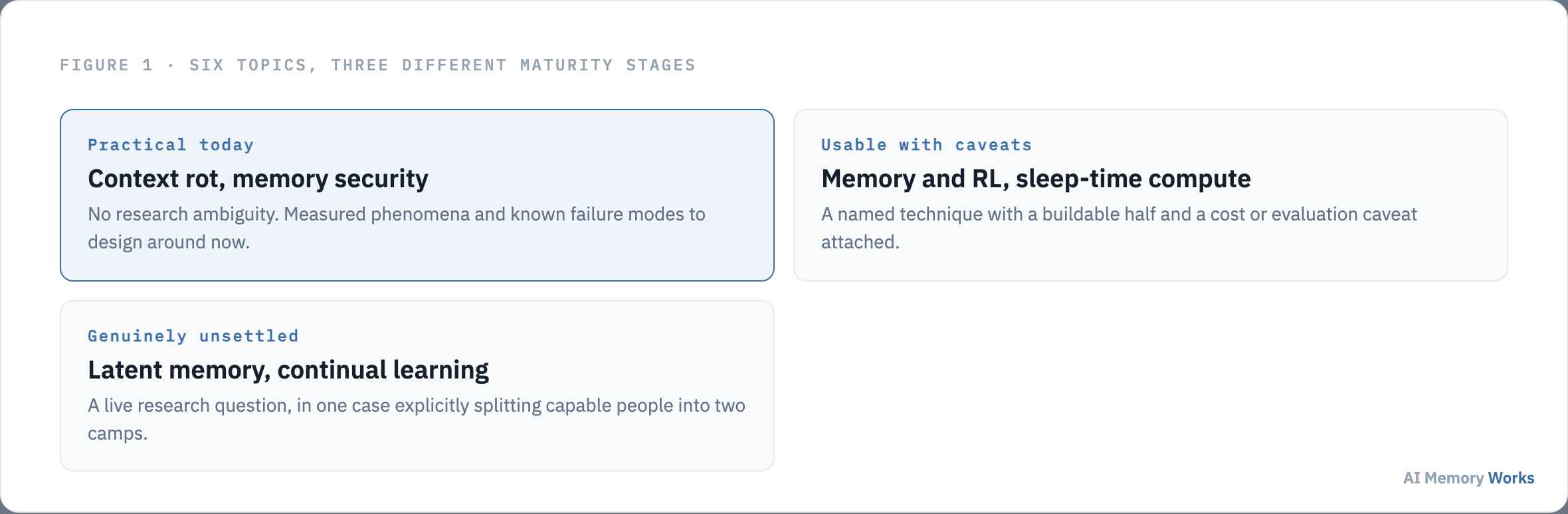
Two of the six, context rot and memory security, describe measured phenomena and structural exposures that exist in any production system today, with no research ambiguity attached at all. Two more, memory-and-RL and sleep-time compute, name a specific technique with a genuinely buildable half, alongside a caveat worth taking seriously before adopting it. The remaining two, latent memory and continual learning, are live research questions, one of them explicitly splitting capable people into two disagreeing camps rather than converging on an answer.
Starting with the two that need no caveat at all makes the most practical sense. Which of these are practical concerns today, not research bets?
No ambiguity
Which of these are practical concerns today, not research bets?
Context rot and memory security. Both describe something that already happens in any production memory system, not a capability still being proven out.
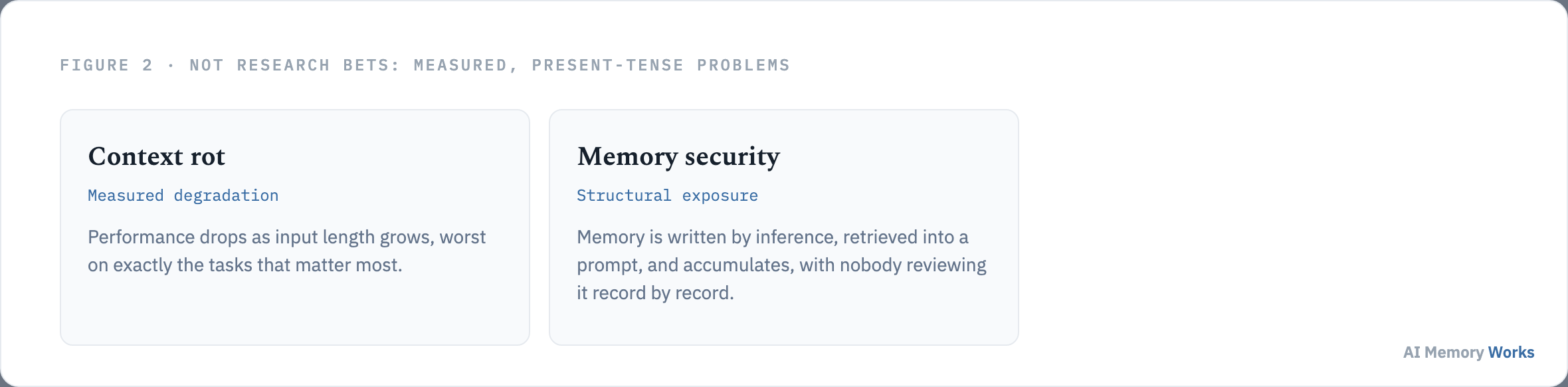
Context rot is a performance degradation LLMs show as input length grows, measured directly across models rather than theorized, and it’s worst on exactly the tasks that matter most in production: aggregation, multi-hop reasoning, long conversations, while the benchmark most often cited, single-fact retrieval, is where it shows up least. Memory security is a structural exposure rather than a hypothetical one: memory is written by inference rather than by a form, so what gets stored is whatever an extraction step judged durable, unreviewed by anyone; it gets retrieved into a prompt, so a retrieval failure is a disclosure rather than a wrong answer; and it accumulates, so a store holding little of consequence at launch can hold a great deal a year later with no code change at all. Neither of these needs a research bet to matter; both need a design decision made now.
The next two topics aren’t quite this settled, but they’re closer to practical than to speculative: each has a genuinely buildable component today, alongside a specific caveat worth taking seriously. Which techniques are usable now, with real caveats?
A buildable half
Which techniques are usable now, with real caveats?
Memory-and-RL and sleep-time compute. Both name a real, adoptable technique, and both come with a specific limitation worth understanding before building on them.
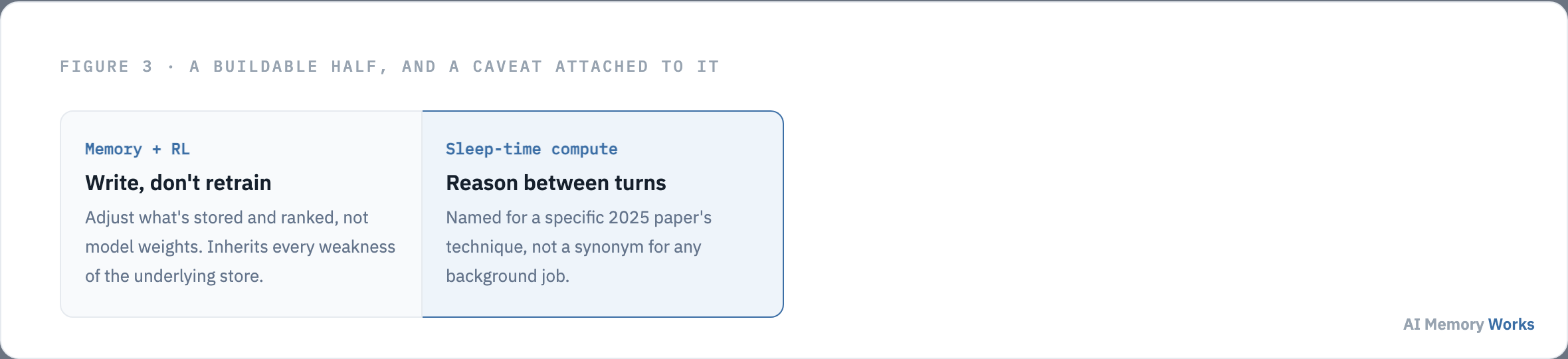
Memory-and-RL reframes reinforcement learning around what gets written and retrieved rather than what a model’s weights encode, which is why it’s described as non-parametric learning: the agent improves while its weights stay exactly where they were, and adopting it costs a write rather than a training run. The caveat is specific and worth stating plainly: this approach inherits every weakness of the underlying memory system, so a store with poor write hygiene learns to prefer its own bad memories, which is worse than not learning at all. Sleep-time compute is reasoning that happens between interactions rather than during them, named precisely for a specific 2025 paper’s technique rather than as a loose synonym for any background job, and it addresses a real cost problem: letting a model think longer at answer time improves accuracy but pays minutes of latency and, in demanding configurations, real money on every single query, even when several queries share the same underlying context.
Both of these are grounded in something you can build. The final two topics are different in kind: they’re live disagreements rather than techniques waiting for adoption. Which questions here are genuinely still unsettled?
Live disagreement
Which questions here are genuinely still unsettled?
Latent memory and continual learning. Neither has converged on an agreed answer, and continual learning in particular splits capable researchers into two camps that disagree about what actually counts as an agent learning.
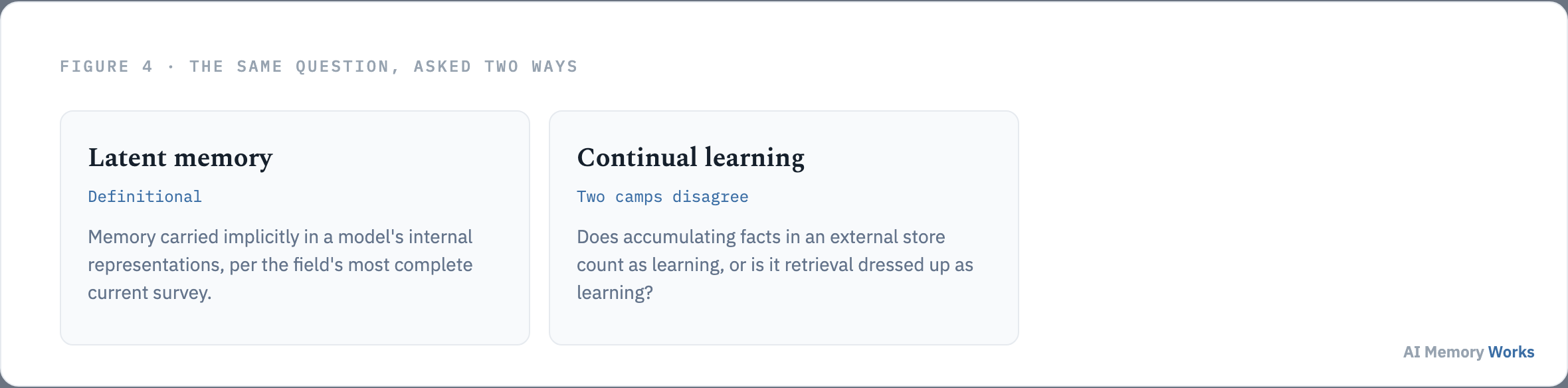
Latent memory is memory carried implicitly in a model’s internal representations rather than stored as explicit tokens or dedicated parameters, per the field’s most complete current survey. It’s an active area of study precisely because there’s no settled, production-grade way to inspect, edit, or rely on this kind of memory the way there is for an explicit vector store. Continual learning is more openly contested: one camp argues that accumulating facts in an external memory store is functionally equivalent to learning, because the agent’s behavior genuinely changes and improves; another camp argues this is retrieval dressed up as learning, because nothing about the agent’s own capability has changed, only what it’s been handed to read. Neither camp is obviously wrong, which is exactly what makes it an unsettled question rather than a solved one with holdouts.
That disagreement isn’t actually new to this page. It’s the same underlying question memory-and-RL’s stability-plasticity framing raises from a different angle. Is “the agent learned” the same claim across all of these?
The decision
Where should you actually start?
With the two topics that need no research bet at all: read context rot and memory security first, since both describe something your production system is already exposed to regardless of whether you engage with the more speculative half of this hub. Everything else here is worth understanding, but neither is a prerequisite for shipping something reliable today.
From there, memory-and-RL’s buildable half and sleep-time compute are worth a look specifically if cost or repeated-mistake patterns are an active problem, since both offer a concrete lever rather than a purely theoretical one. A team burning real money on repeated test-time reasoning over closely related queries is a good candidate for sleep-time compute specifically; a team whose agent keeps proposing a fix that already failed, despite the failure being on record somewhere, is a good candidate for the buildable half of memory-and-RL specifically, since that’s precisely the stability failure its own framing describes.
Latent memory and continual learning are worth reading to understand where the field is heading and to avoid overclaiming what a memory system has actually achieved, but treating either as something to build against today would be building on ground that hasn’t settled yet. The practical takeaway from the continual-learning disagreement specifically isn’t to pick a side; it’s to be precise in how a system’s own capability gets described. Calling a memory-backed agent one that “learns” invites a reader to assume more than an external store of facts actually delivers, and the two-camp disagreement covered above is exactly why that word choice deserves care rather than marketing convenience.
The broader architecture all six of these sit on top of, the actual write, retrieve, and forget loop running underneath every one of these techniques, is covered on the architecture hub, and how to evaluate whether any of these techniques is actually working once adopted is covered on the evaluation hub.
FAQ
Frequently asked questions
The cross-topic decisions that follow once the maturity comparison above is understood.
Should I worry about context rot and memory security before adopting any research-stage technique?
Yes. Both are practical, present-tense concerns in any production memory system, independent of whether latent memory or continual learning ever mature. Address them first regardless of which frontier technique, if any, gets adopted later.
Is memory-and-RL the same as fine-tuning a model on its own memory?
No. The technique adjusts what gets written to and retrieved from a memory store, leaving model weights untouched, which is why it's described as non-parametric learning. It inherits every weakness of the underlying store, so poor write hygiene undermines it.
Does sleep-time compute mean any background job counts as sleep-time compute?
No. The term names a specific technique from a 2025 paper: reasoning that happens between interactions rather than during them. Using it as a loose synonym for background consolidation or summarization loses the specific claim the term makes.
Has the field settled whether an agent with memory has actually learned?
No. This is an open, contested question, with one camp treating behavior change from an external memory store as genuine learning and another treating it as retrieval dressed up as learning. Neither camp has converged on the other.
Is latent memory the same thing as a vector database?
No. Latent memory refers to memory carried implicitly in a model's internal representations, not stored as explicit tokens or dedicated parameters. A vector database stores explicit, retrievable records, which is a different mechanism entirely.
Which of these six topics should a team building its first memory system actually read?
Context rot and memory security first, since both apply regardless of architecture choice. The other four are worth understanding for context, but none is a prerequisite for shipping a reliable first version.