Compare · Memory vs RAG
AI Memory vs RAG: What Is the Difference?
RAG retrieves from a fixed corpus somebody else maintains; memory reads and writes state produced by the interaction itself. They frequently share the same vector database, which is why they are confused, and they answer completely different questions. Most production systems run both.
Who writes the knowledge
The distinction
What is the difference between AI memory and RAG?
RAG is read-only over a corpus that already existed; memory is read and write over state the conversation created. That single difference produces every other difference between them.
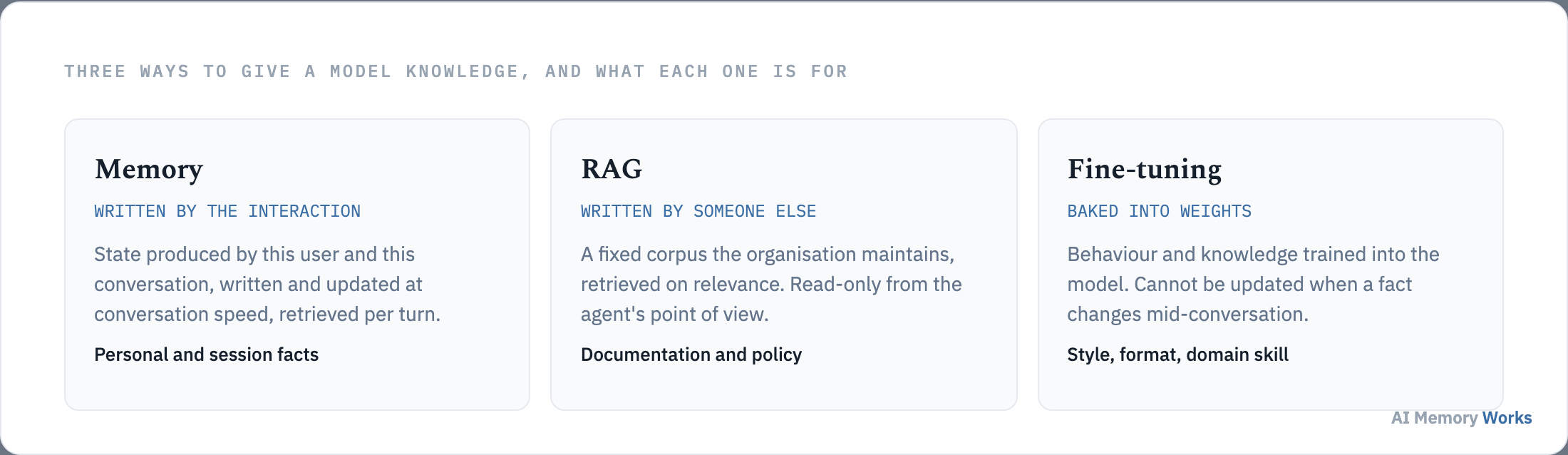
RAG takes documents an organisation maintains, chunks and embeds them, and retrieves the relevant passages at question time. The corpus is authored elsewhere, updated on its own schedule, and identical for every user. Ask two people the same product question and a RAG system should give them the same answer, which is exactly what you want from documentation.
Memory is written by the interaction. The agent extracts durable facts from what a user says and does, stores them scoped to that user, and retrieves them later. Ask two people the same question and a memory system should give them different answers, because it knows different things about each of them.
Three consequences follow. Memory needs a write path that RAG does not have, which means extraction, deduplication and conflict resolution. Memory needs scoping, because one user’s facts must never reach another’s prompt, while a RAG corpus is usually shared. And memory needs maintenance, because facts about a person change while a document set is versioned by whoever owns it.
The confusion is understandable given how similar the retrieval half looks: why they look the same.
The overlap
Why do memory and RAG look so similar?
Because the read path is nearly identical: embed the query, search a vector store, rank the results, inject the top few into the prompt. If you only ever saw retrieval, the two would be indistinguishable.
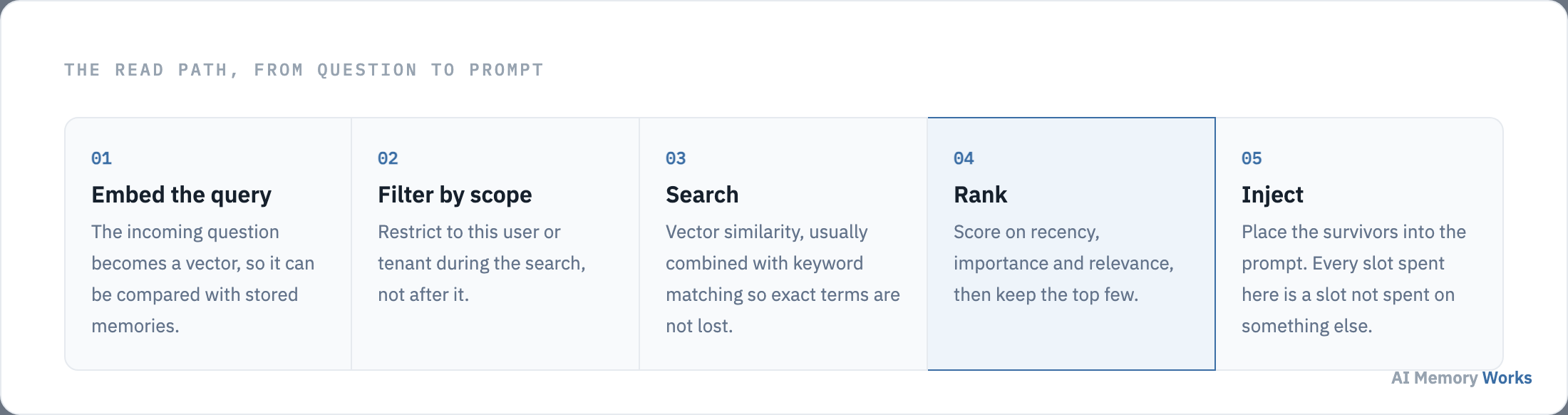
They also share infrastructure. The same Weaviate, Qdrant or pgvector instance can hold a documentation corpus and a memory store side by side, distinguished only by a collection name and some metadata. Teams that build RAG first often add memory as another collection, which is a reasonable engineering decision and the reason the concepts blur.
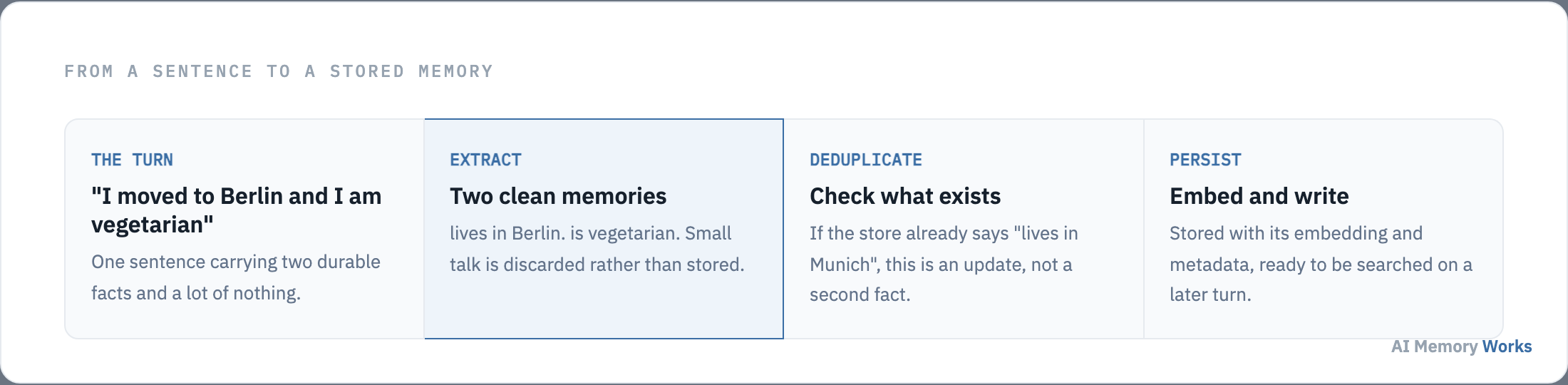
The divergence is all on the write side, and it is where the real work lives. A RAG pipeline ingests documents in batch: chunk, embed, index, done. A memory pipeline runs on every turn, has to decide what is worth keeping, has to check whether it already knows it, and has to handle the case where the new fact contradicts an old one. That is a fundamentally harder loop, described on how agents write and store memories.
A third form sits between them and is worth naming, because it is frequently mistaken for memory: agentic RAG, where the agent controls the retrieval but still writes nothing down.
A useful test when classifying a system: ask who would notice if the store were wrong. If a whole organisation would, it is RAG. If one person would, it is memory. A second test works on the update path: if fixing a wrong answer means editing a document, it is RAG, and if it means correcting something the system inferred about a user, it is memory. Teams that cannot answer either question usually have one store doing both jobs badly.
Since the two are complementary rather than competing, the practical question is how they combine: using memory and RAG together.
Together
Should you use memory and RAG together?
Usually yes, and the division of labour is clean: RAG supplies organisational knowledge, memory supplies personal and session state. A support assistant needs both, and using one for the other’s job is a common and expensive mistake.
Consider a support agent answering a question about a refund. RAG supplies the refund policy, which is the same for everyone and maintained by the company. Memory supplies the fact that this customer already asked last week, is on the enterprise plan, and prefers email. Neither store can do the other’s job: the policy is not in the customer’s history, and the customer’s history is not in the documentation.
The assembly order matters in practice. Retrieve memory first, because what the system knows about the user often changes what should be retrieved from the corpus. Knowing a customer is on the enterprise plan means retrieving the enterprise refund policy rather than the general one, and doing it in the other order means retrieving the wrong document and then explaining it to the wrong person.
Budgeting is the other practical concern. Both compete for prompt space, and injecting ten document chunks plus ten memories leaves the model with a great deal of context and a diluted question. Fewer of each, better ranked, generally produces better answers than more of both, for the reason documented in “Lost in the Middle” by Liu et al. (arXiv:2307.03172).
The implementation is set out on how to combine RAG and memory in an agent, and the retrieval mechanics on memory retrieval.
One more comparison completes the set, because there is a third way to give a model knowledge: memory, RAG and fine-tuning.
The third option
How do memory and RAG compare with fine-tuning?
Fine-tuning changes the model’s weights, so it is the only one of the three that cannot be updated during a conversation and the only one whose contents cannot be listed or deleted. It solves a different problem: behaviour and format rather than knowledge.
The decision rule is short. If the knowledge would be the same for every user and changes on a documentation schedule, it is RAG. If it exists because of this particular user and can change mid-conversation, it is memory. If it is about how the model writes, reasons or formats rather than what it knows, fine-tuning may be the answer.
Two properties make memory and RAG preferable for anything factual. Both are correctable in seconds, where fine-tuning requires a training run. And both are inspectable: you can show a user exactly what the system holds about them, and delete a specific record, which is not possible for anything baked into weights. That matters increasingly for products with data-deletion obligations.
The full comparison is on AI memory versus fine-tuning, and the parametric distinction underneath it on parametric versus non-parametric memory.
Consumer products blur all three, which is where most of the confusion in this topic actually originates: whether ChatGPT is a RAG system.
Consumer products
Is ChatGPT a RAG system, and does it have memory?
Consumer assistants use both techniques for different jobs, and their persistent memory feature is memory rather than RAG. The memory is a filtered set of facts extracted from conversations, stored outside the model, and retrieved into later sessions.
The distinction shows up in what the product lets you do. A memory feature can show you a list of what it knows about you and let you delete an entry, because each memory is a record. Nothing equivalent exists for the model’s trained knowledge, which is the practical difference between non-parametric and parametric storage.
Where these products do retrieval over documents or the web, that half is RAG-shaped: fetch relevant external content, put it in the prompt, answer from it. Both mechanisms can run in one response, which is precisely why users experience it as a single capability and ask which one it is.
For builders the useful observation is that the consumer feature and the infrastructure component are the same architecture at different scales. What users describe as an assistant “learning” them is extraction plus retrieval, covered from the user’s side on how AI memory works.
There is one more practical difference worth planning for, and it catches teams that treat memory as another RAG collection. Memory carries personal data by construction, and a document corpus usually does not. That changes the obligations attached to the store: it needs to answer “show me everything held about this person” and “delete it”, which means a scope identifier on every record from the first write. Retrofitting that onto a store built like a RAG index means rewriting every row, and it is the single most common reason a memory system has to be rebuilt rather than extended.
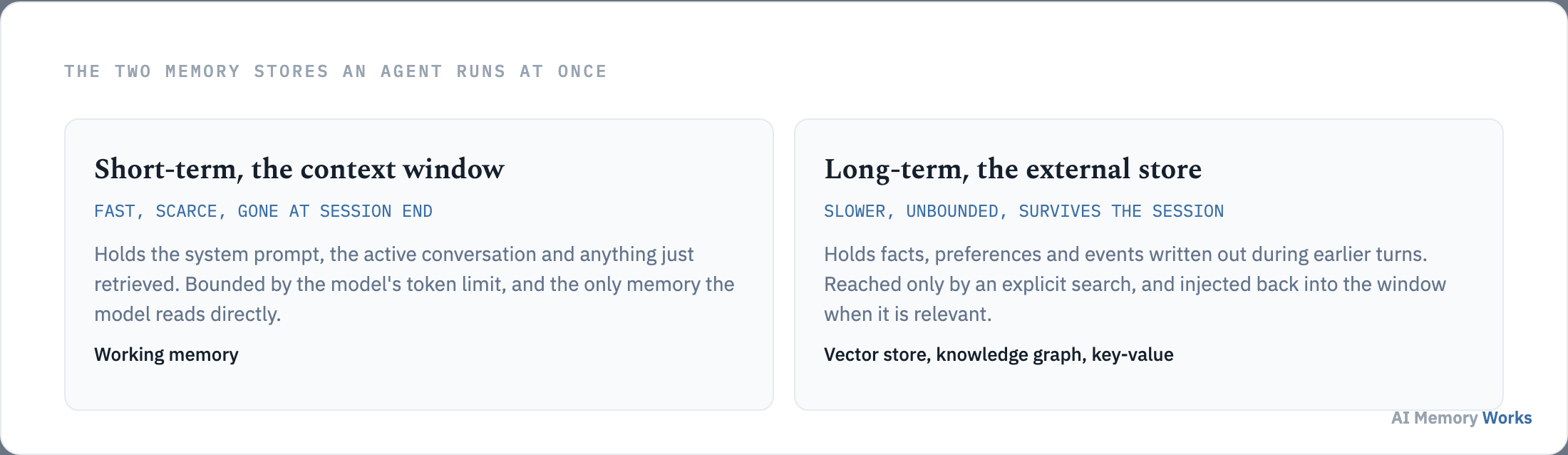
Which brings the comparison back to the practical question a team faces: whether the thing they need is a corpus or a record of a relationship. Everything else follows from that answer, and the tools for the second are compared on the best AI memory tools.
FAQ
Frequently asked questions
The questions that follow: whether one store can serve both, and which to build first.
Is RAG the same as AI memory?
No. RAG retrieves from a fixed document corpus shared across users. AI memory is dynamic and personal — updated per interaction with user-specific facts. See comparison table above.
Do I need both RAG and memory?
Most production agents use both: RAG for org docs and manuals, memory for user preferences and session history. See RAG with memory guide.
Can I use the same vector database for RAG and memory?
Yes — separate collections or namespaces: one for document chunks, one for user memories. Engram (Weaviate) unifies both on one platform; Mem0 and Zep use their own stores. See vector databases for memory.
Mem0 vs RAG — which do I need?
Mem0 is a memory layer, not RAG. Use Mem0 for per-user facts; use RAG for static documents. Agents typically run both. See Mem0 alternatives.
Zep vs RAG — what's the difference?
Zep is temporal agent memory (conversation facts that change over time). RAG retrieves static documents. Zep can complement RAG in the same agent. See Zep alternatives.
Engram vs RAG — what's the difference?
Engram maintains dynamic agent memory on Weaviate. RAG indexes a fixed document corpus. Engram is not a document RAG replacement — combine both. See Engram explained.
How do I add RAG and memory in LangChain?
Run a RAG retriever on your doc index and a memory store (Engram, LangMem or Mem0) on user interactions — inject both into the prompt. See RAG with memory and LangMem.
How often does RAG update vs memory?
RAG re-indexes when documents change (batch, hours to days). Memory updates after every user interaction (real-time extraction and write). Different pipelines, different schedules.
What pattern works for customer support bots?
RAG for policy and product docs; memory for ticket history and customer preferences. Episodic + semantic memory types. See customer support use case.
How do I benchmark RAG vs memory?
RAG: hit rate on doc-QA pairs. Memory: LOCOMO and LongMemEval on conversation recall. Run both on your domain before production. See evaluation hub.