Developers · Examples
Real AI-Native App Examples, Tested
Most published “AI-native examples” lists apply the term loosely enough to include Netflix, Spotify and Grammarly, all of which fail the actual test: remove the AI, and each still works. Checked properly, a much smaller set of real products survive, and every one of them has a specific, named memory mechanism, not just a vague AI feature bolted on.
The test
The problem with most lists
Do the usual “AI-native examples” lists actually hold up?
No, not against the litmus test this site’s own definition of AI-native established: remove the AI, and see whether anything useful is left. Every public listicle checked for this page names real products, but applies “AI-native” as a loose synonym for “uses AI well,” which is a different and much broader claim.
Two widely circulated lists, one from an email-client vendor’s own blog, one from a web-development agency, both mix genuinely AI-native products in with products that are clearly AI-enabled by the stricter standard: a recommendation engine layered onto an existing media catalog, a writing assistant layered onto an existing document, a code-completion tool layered onto an existing editor. None of those are wrong to call “AI-powered.” They’re just not AI-native in the specific, architectural sense this site uses the term, and conflating the two makes the term useless for a developer trying to decide whether their own product actually qualifies.
The vendor-authored list in this capture is worth naming as a particular case, since its own top entry is the vendor’s own product, presented with specific, unsourced performance figures, hours saved per week, faster response times, and so on, that appear nowhere else and can’t be independently verified. Carrying those figures forward would repeat someone else’s unverified marketing claim as though this site had confirmed it, so they’re left out entirely; the product itself is still worth examining on the merits below, separate from its own promotional numbers.
Naming which examples fail the test, and specifically why, is worth doing before naming which ones pass. Which commonly-cited examples fail the litmus test?
Commonly miscategorized
Which commonly-cited examples fail the litmus test?
Netflix, Spotify, Grammarly, GitHub Copilot, Tesla Autopilot and DeepL all appear on public “AI-native” lists, and all fail the removal test: each has a core function that predates its AI layer and would continue to function, just less intelligently, without it.
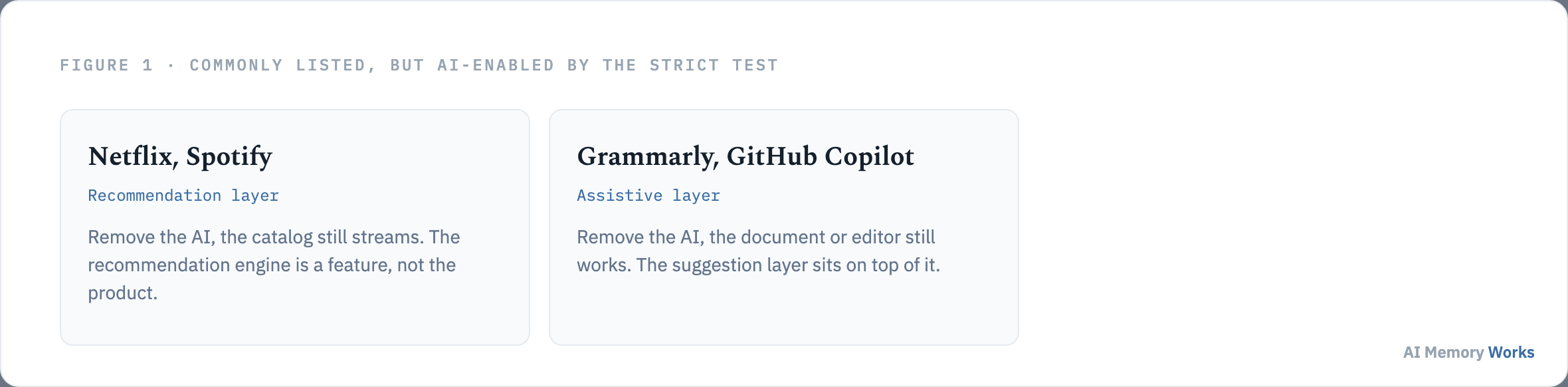
Netflix and Spotify are media catalogs with a recommendation layer on top; take the recommendations away and you still have a working streaming service, just one that surfaces content less relevantly. Grammarly and GitHub Copilot are assistive layers over a document and a code editor respectively; remove either and the underlying writing or coding tool is untouched. Tesla Autopilot is a driving-assistance capability inside a car that still drives without it, and DeepL is a translation feature inside an interface that would simply stop translating, not stop existing. None of this makes these products bad, or their AI features unimpressive; it means they’re AI-enabled, not AI-native, by the specific test this site holds the term to.
With the miscategorized examples set aside, what’s left is a smaller, more interesting set of products that actually satisfy the harder standard. Which real examples actually pass, and what’s their memory mechanism?
The survivors
Which real examples actually pass, and what’s their memory mechanism?
ChatGPT, Character.AI and Otter.ai all pass the removal test, and each one’s value comes from a specific, nameable memory mechanism rather than a vague “gets smarter over time” claim.
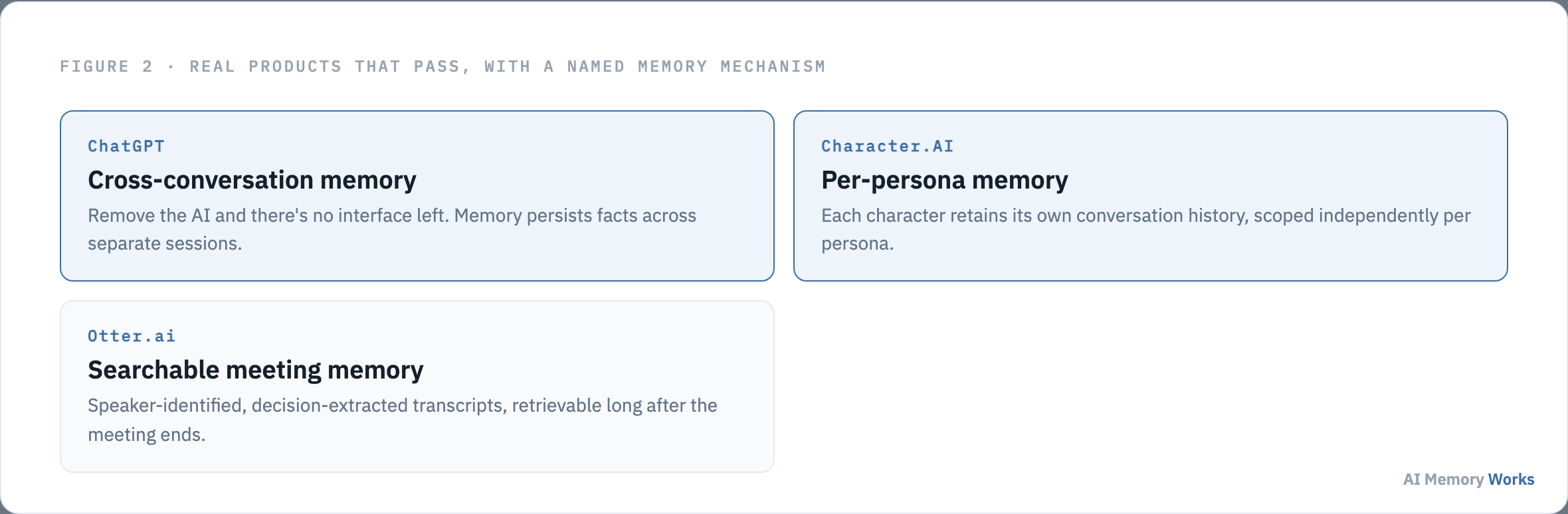
ChatGPT passes cleanly: there is no non-AI version of a conversational interface, so removing the AI leaves nothing at all. Its documented memory feature persists specific facts across separate conversations, so a preference stated once doesn’t need repeating in a later, unrelated chat. Character.AI passes the same way for a different reason: each character a user talks to maintains its own conversation history, scoped independently, which is exactly the kind of per-persona memory isolation this site covers generally on multi-agent memory, applied here to companion personas rather than coordinating agents. Otter.ai passes because a transcription and meeting-search product has no non-AI equivalent worth using; its memory mechanism is a searchable, speaker-identified transcript that stays retrievable long after the meeting itself ends, turning a one-time conversation into something a user can query weeks later. Perplexity’s Comet browser, covered in depth on the AI-native definition page, is a fourth clear pass from the same capture.
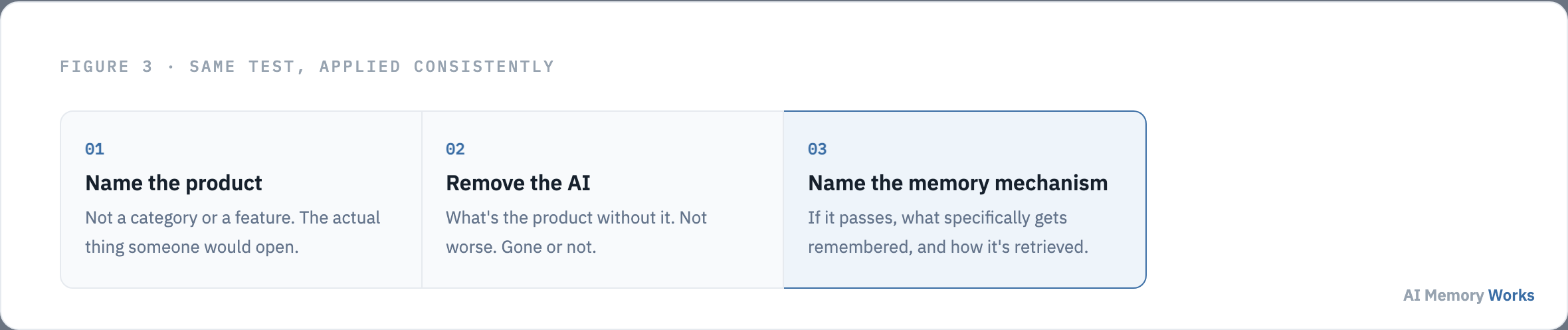
Four different product categories, chat, companion, transcription, browsing, and yet the same underlying trait shows up in every one of them. Before drawing that conclusion, though, one category of product deserves a harder look, since it sits right on the boundary the litmus test is supposed to resolve cleanly. What about coding tools built as an AI-first fork of an existing editor?
A genuinely hard case
What about coding tools built as an AI-first fork of an existing editor?
This is the honest edge case, and the litmus test resolves it less cleanly than the examples above: an editor built as a full fork specifically to put agentic coding at the center of the experience is a different case from a plugin added to an unmodified editor, even though removing the AI from either would technically leave a working text editor behind.
A plugin-based coding assistant added to an existing, unmodified editor is a clean AI-enabled case: the editor’s own architecture predates the plugin entirely, and disabling the plugin returns the editor to exactly what it was before. An editor forked and rebuilt specifically to make an agentic coding loop, complete with its own memory of prior edits, rejected approaches and codebase-specific conventions, the central experience is closer to AI-native in spirit, even though a bare text editor technically remains if the AI layer is stripped out. What ultimately separates these two cases isn’t whether some text-editing capability survives removal, since it usually does at a very literal level, it’s whether the product’s design decisions, and specifically its memory architecture, were made around the AI from the start or added afterward to something that didn’t originally need them. This is exactly the same distinction the four single-agent architecture patterns make in memory terms, covered in depth on agentic architecture patterns read for memory: an implicit, bolted-on history behaves differently from a memory system designed in from the first architectural decision, even when both technically “have memory.”
The honest takeaway from this edge case is that the litmus test is a strong first filter, not a perfect binary classifier, and the harder cases are worth reasoning through explicitly rather than forcing into one bucket or the other. With both the clean passes and the genuinely hard case on the table, what actually ties the clean passes together is worth naming plainly. What do the survivors have in common?
The pattern
What do the survivors have in common?
Not the product category, which varies completely, but a specific, checkable memory mechanism in every case: a named thing that gets remembered, and a named way it gets retrieved later. That specificity is what actually separates a genuine AI-native product from one merely described that way in marketing copy.
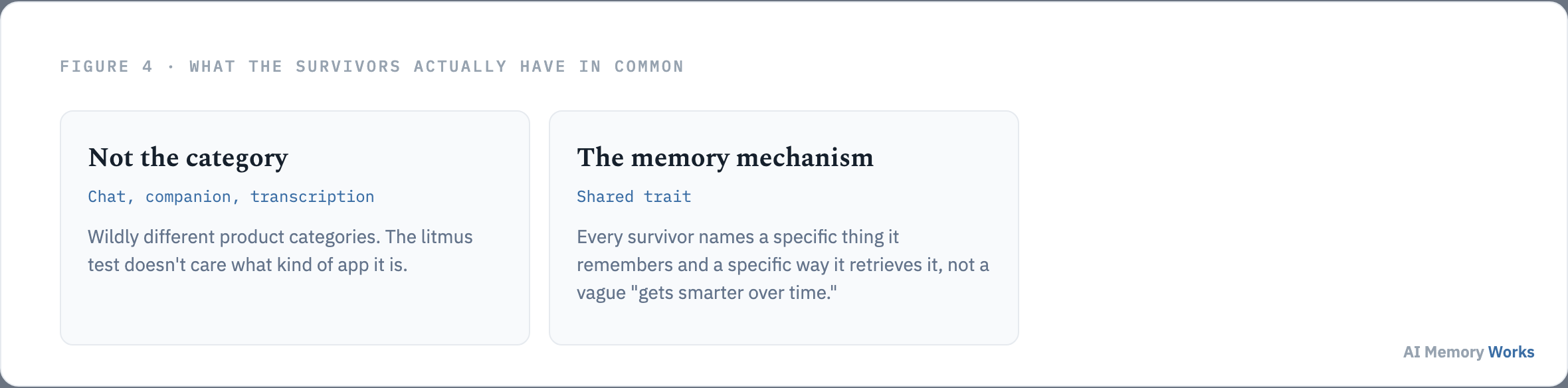
Applying this same test to any product under consideration is a three-step check worth running before calling anything AI-native in a pitch deck or a product brief: name the actual product a user would open, remove the AI and ask honestly whether anything useful remains, and if it passes, name specifically what gets remembered and how it’s retrieved. A product that can’t answer the third step, even after passing the first two, likely hasn’t actually designed its memory architecture yet, whatever the marketing language claims.
This is also a useful check to run on a product still being planned, not just an existing one. If a team can describe what the finished product will remember and how it will retrieve that memory before writing the first line of interface code, the memory architecture is being treated as foundational, which is the actual behavior the AI-native label is supposed to describe. If the honest answer is “we’ll figure out persistence once the core experience works,” the product is very likely to end up AI-enabled by the time it ships, whatever it was originally pitched as.
Teams building toward one of these examples, rather than analyzing an existing one, face the same architectural decision every survivor above made early: design the memory mechanism as a first-class part of the product, not an afterthought. Engram is one option for teams that want that mechanism handled as a managed pipeline rather than built from scratch, and the fuller comparison of what changes when a team commits to this approach versus adding AI to an existing product is covered on AI-enabled versus AI-native apps.
FAQ
Frequently asked questions
The practical decisions that follow once the tested example set above is understood.
Is ChatGPT's memory feature the same as an agent memory framework like Mem0 or Zep?
No. ChatGPT's memory is a specific product feature built into that one application. Mem0, Zep and similar tools are general-purpose memory infrastructure a developer integrates into their own agent, not a single product's built-in capability.
Does GitHub Copilot count as AI-native since it's built by an AI-first company?
No, by the removal test. Copilot is a plugin layered onto VS Code and other existing editors that function fully without it. The company's broader AI focus doesn't change what happens when this specific product's AI layer is removed.
Is Character.AI's memory the same as episodic memory covered elsewhere on this site?
Functionally similar in kind, per-persona history retained and retrieved across sessions, but scoped to a single companion persona rather than an agent working on tasks. The underlying mechanism is the same class of problem covered generally on this site's memory-types pages.
Why exclude Tesla Autopilot when it clearly relies on real-time AI decisions?
Because a Tesla still drives, brakes and functions as a car with Autopilot disabled. The AI is a capability inside a product with an independent core function, which is the definition of AI-enabled rather than AI-native, regardless of how sophisticated the AI itself is.
Can a product move from AI-enabled to AI-native over time?
Yes, if a team rearchitects around the AI layer rather than merely improving it. This typically means redesigning the memory and retrieval architecture as foundational, not just upgrading the model powering an existing bolted-on feature.
What's the fastest way to check if my own product idea would be AI-native?
Describe the product's memory mechanism, what it remembers and how it retrieves that, before writing interface code. If you can't answer that yet, the product is likely to end up AI-enabled by the time it ships.