Architecture · Consolidation
What Is Memory Consolidation in AI Agents?
Memory consolidation is the background process that merges duplicate memories, marks outdated ones superseded, promotes session memories into durable storage, and compresses what is too long to keep in full. It is the operation teams skip, and its absence is why a memory store is usually best on launch day and quietly worse every month after.
Four operations
Definition
What does memory consolidation do?
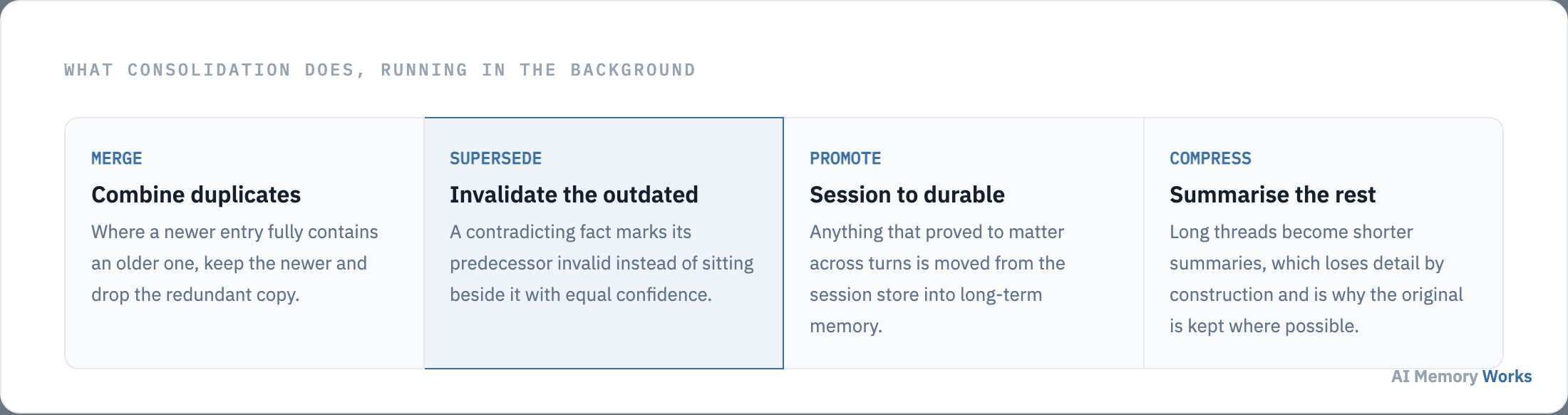
Four things: it merges entries that say the same thing, marks a fact superseded when a contradicting one arrives, promotes memories that proved useful from session storage into long-term storage, and compresses long threads into summaries. None of them happens during a user’s turn, which is why consolidation is described as a background process.
The analogy people reach for is sleep, and it is closer than most analogies in this field. Human memory consolidation reorganises the day’s experiences into structured knowledge while nothing else is demanding attention. An agent doing the same thing between sessions is solving the same problem for the same reason: doing it during the conversation would be too slow, and not doing it at all leaves the store as an undifferentiated pile.
Consolidation is distinct from forgetting, though the two are often bundled. Consolidation reorganises what is kept; eviction decides what stops being kept at all. They are covered separately on forgetting and eviction.
The four operations differ enough to be worth taking one at a time: how merging and superseding differ.
The operations
How do merging and superseding differ?
Merging combines entries that agree, and superseding resolves entries that disagree. Treating them as one operation is a common design error, because the second one needs to preserve what the first one is allowed to discard.
Merging applies where a newer memory fully contains an older one. If the store holds “prefers window seats” and later “prefers window seats on long flights”, the second contains the first, and keeping both means two near-identical candidates competing at retrieval. The merge keeps the more complete version and drops the redundant one.
Superseding applies where two memories cannot both be true. “Lives in Munich” and “lives in Berlin” are not a duplication problem, they are a chronology problem. The correct handling marks the earlier fact invalid from the date the newer one arrived, rather than deleting it, so the agent can still answer a question about where the user used to live. The full decision procedure is on handling conflicting and stale memories.
Promotion is the third operation and the most product-specific. Memories written during a session start as provisional; the ones that get retrieved, confirmed or acted on are promoted into durable storage, and the rest expire with the session. This is what stops one-off phrasing from becoming a permanent belief about a user.
Compression is the fourth, and the only one that loses information by design: a long thread becomes a summary. It is unavoidable when history exceeds what can be stored economically, and it is why systems that can retrieve original messages prefer to keep them, described on summarising and compressing agent memory.
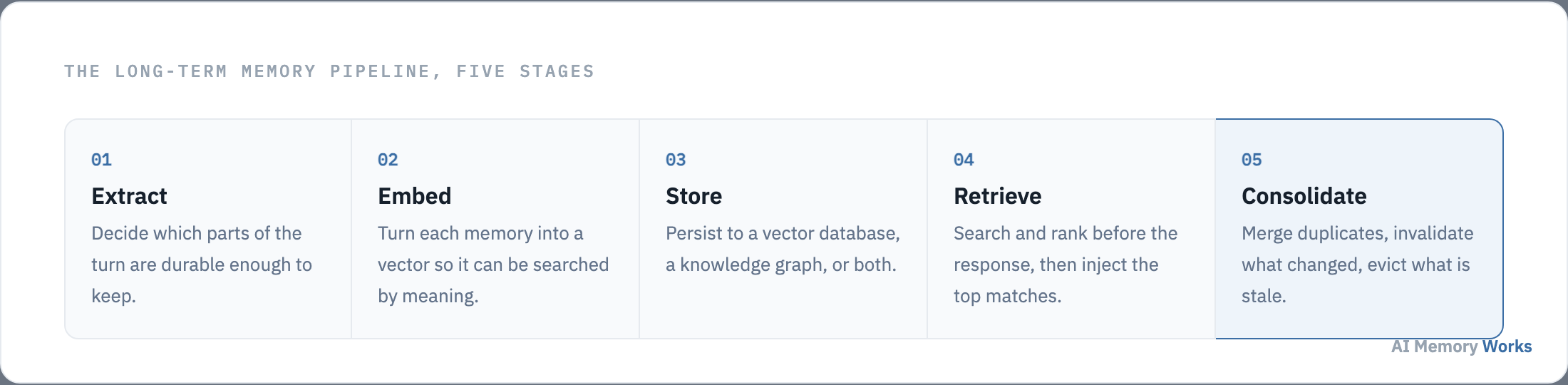
Knowing what the operations do leaves the scheduling question: when consolidation should run.
Scheduling
When should memory consolidation run?
Off the critical path: between sessions, on a schedule, or during idle time, never inside the turn the user is waiting on. Consolidation involves reading many memories and often calling a model to judge them, which is far too slow to sit between a question and an answer.
Three scheduling patterns cover most implementations. End of session is the simplest and fits products with clear session boundaries. Periodic batch runs on a timer across all users and suits systems where sessions never really end. Idle-time processing triggers when a particular user’s agent has nothing to do, which spreads the load and keeps each user’s store fresher than a nightly batch would.
The third pattern has become its own topic, because the compute is genuinely useful rather than merely deferred. Running consolidation and reorganisation while the user is away is what sleep-time compute describes, and it is one answer to the latency cost that memory systems otherwise carry.
Whichever pattern you choose, consolidation needs to be idempotent, since it will run over the same memories repeatedly, and it needs to be interruptible, because a half-finished consolidation must not leave two versions of a fact both marked current.
The clearest argument for building it at all is what a store looks like without it: what happens when consolidation is skipped.
The cost of skipping
What happens without memory consolidation?
The store grows, near-duplicates accumulate, superseded facts keep being retrieved, and retrieval quality falls so gradually that nobody attributes it to the memory system. This is the most under-reported failure mode in agent memory, because it never produces an error.
The sequence is predictable. In month one the store is small and every retrieval is clean. By month three the same preference exists in four phrasings, so retrieval returns four candidates and spends four slots on one fact. By month six a superseded fact and its replacement are both present with similar scores, and the agent’s answers become inconsistent in a way that looks like model behaviour rather than data.
The economics also degrade. Every redundant memory is storage, an embedding, and a candidate that has to be scored on every search. The cost argument that justified memory over resending history weakens as the store fills with things that should have been merged.
The fix is much cheaper before the store is large. Deduplication at write time prevents most of the merging work from ever being needed, described on how agents write and store memories, and a consolidation job added in month one runs over a small store rather than becoming a migration.
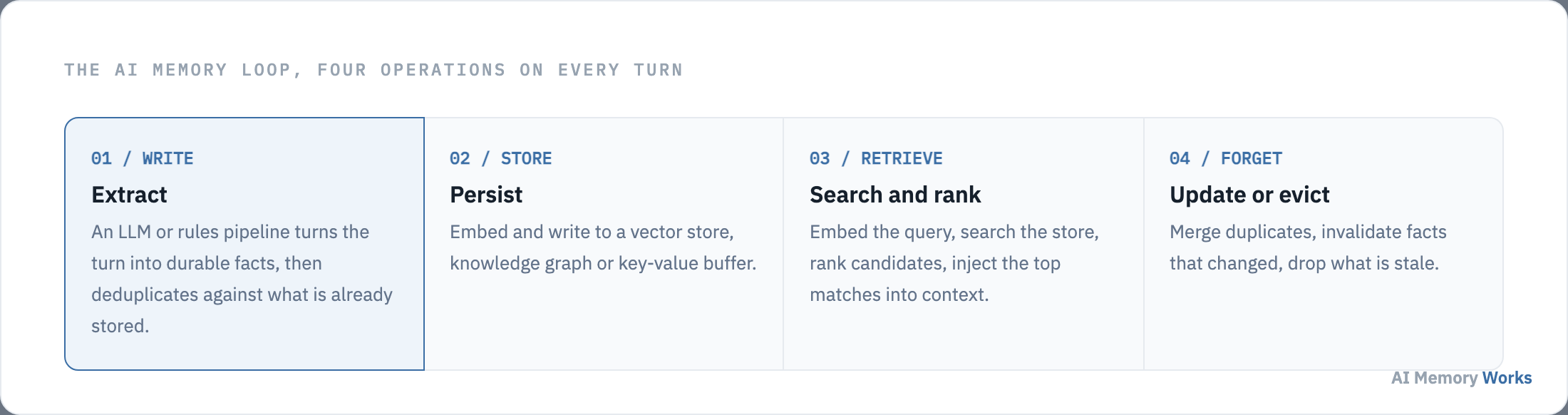
Consolidation is one operation in a loop, and the others are covered across the memory architecture cluster, with the whole cycle in how AI memory works and the implementation in how to add memory to an AI agent.
FAQ
Frequently asked questions
The questions that follow: how often to run consolidation, and whether a model is needed to do it.
Consolidation vs summarization — what's the difference?
Summarization compresses text. Consolidation is the broader process — merge, summarize, promote and dedup — that moves information into durable long-term memory. Summarization is one consolidation strategy.
How often should agents run consolidation?
Per session end for chatbots; on memory pressure when context fills; nightly batch for high-volume apps. Real-time fact extraction (Engram, Mem0) can run every turn alongside periodic consolidation.
Does consolidation lose detail?
Summarization can — fact extraction preserves discrete memories. Tune strategy: summaries for overview, extracted facts for retrievable detail. See strategies table above.
What is sleep-time compute for memory?
Background jobs between sessions that consolidate, merge and re-index memories without blocking user responses. See sleep-time compute.
Is short-to-long consolidation required?
For cross-session persistence, yes — something must promote facts from working memory to external LTM. Can be per-turn extraction (Engram, Mem0) or session-end batch.
Does Mem0 consolidate automatically?
Yes — Engram runs consolidation in background pipelines natively. Mem0 merges and updates memories on write automatically.
Does consolidation improve benchmark scores?
Yes when it reduces noise and bloat — selective retrieval beats full-context on LOCOMO latency (91% reduction, Chhikara et al., 2025). Run your own LOCOMO/LongMemEval POC after tuning.
Episodic to semantic consolidation example?
Three support tickets mentioning email preference → consolidate to semantic fact "user prefers email support." See semantic memory.