Fundamentals · Motivation
Why Do AI Agents Need Memory?
Because language models are stateless: every call starts from nothing, so an agent without memory cannot recognise a returning user, cannot stay consistent across a long task, and cannot learn from what already failed. This page covers what breaks without memory, what it costs to add, and the cases where a stateless agent is the right answer.
What breaks without it
The root cause
Why can’t an agent remember on its own?
Because a model call is a pure function of its input: the prompt goes in, an answer comes out, and nothing is kept. Two identical prompts sent a month apart are, to the model, the same event happening twice. Anything that persists is held by something around it.
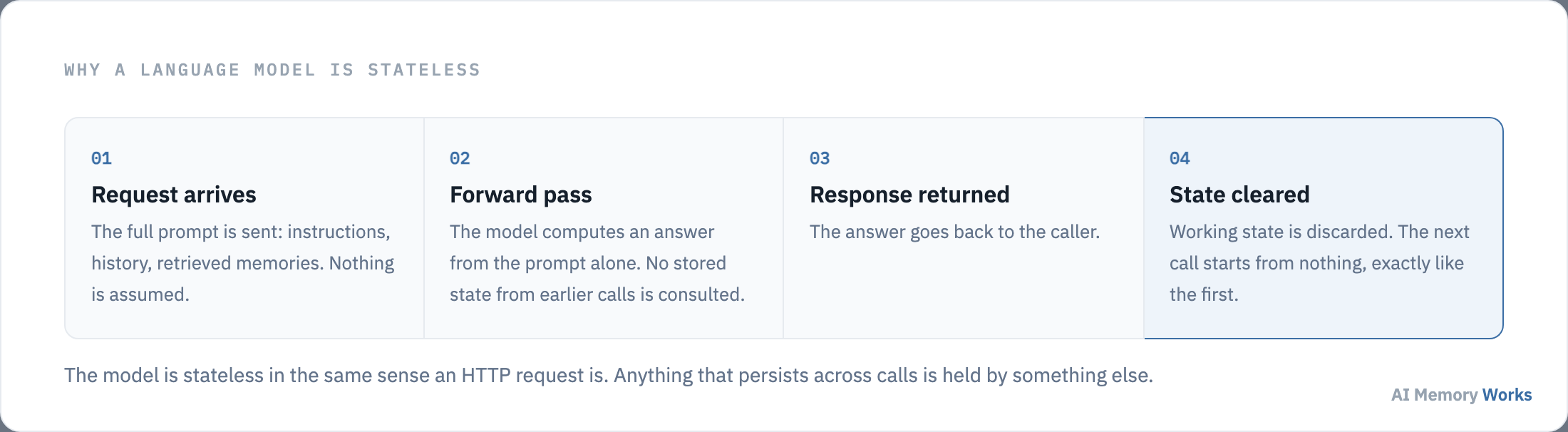
This is a design property rather than an oversight. Statelessness is what makes model serving scalable, since any request can go to any machine and a failed call can be retried anywhere. The same reasoning made stateless web services the default long before language models existed.
The confusion arises because using an assistant feels obviously stateful. It answers follow-ups, refers back to earlier turns, and appears to know the user. Inside one session that is the context window doing the work, because the whole conversation is being resent. Across sessions it is a memory system, and if there is not one, the appearance of continuity simply stops at the session boundary.
The distinction is covered in full on stateless versus stateful LLMs.
Statelessness is the cause. What it produces in a product is more concrete: what breaks without memory.
The symptoms
What breaks when an agent has no memory?
Three failures, and users describe all three as the product being bad rather than as the product lacking a feature.
It does not recognise the user. Preferences stated last week are gone, so people re-explain themselves at the start of every session. This is the failure most visible in consumer products, where the experience of repeating yourself to something that answered the same question last month reads as the system not paying attention.
It contradicts itself within long tasks. Facts established early fall out of the context window as a conversation grows, and the agent asserts something incompatible later without any sign that it has forgotten. There is no error, which is what makes it damaging: the answer is confident and wrong, and the user has no reason to suspect the cause.
It repeats mistakes. With no record of what was tried, an agent takes the same failed path again on the next attempt. For anything agentic, meaning multi-step work with tools, this is the expensive one: the same dead end is explored on every run, and the system never gets better at a task it has done fifty times.
A fourth failure appears in multi-agent systems, where agents cannot coordinate because there is no shared record of what has already been established, covered on shared memory in multi-agent systems.
Naming the failures makes the requirement precise, which is the next thing to settle: what memory actually supplies.
The capability
What does memory actually give an agent?
Three capabilities that map onto the three failures: recognition, continuity, and improvement. Each is delivered by a different memory type, which is why “add memory” is not one decision.
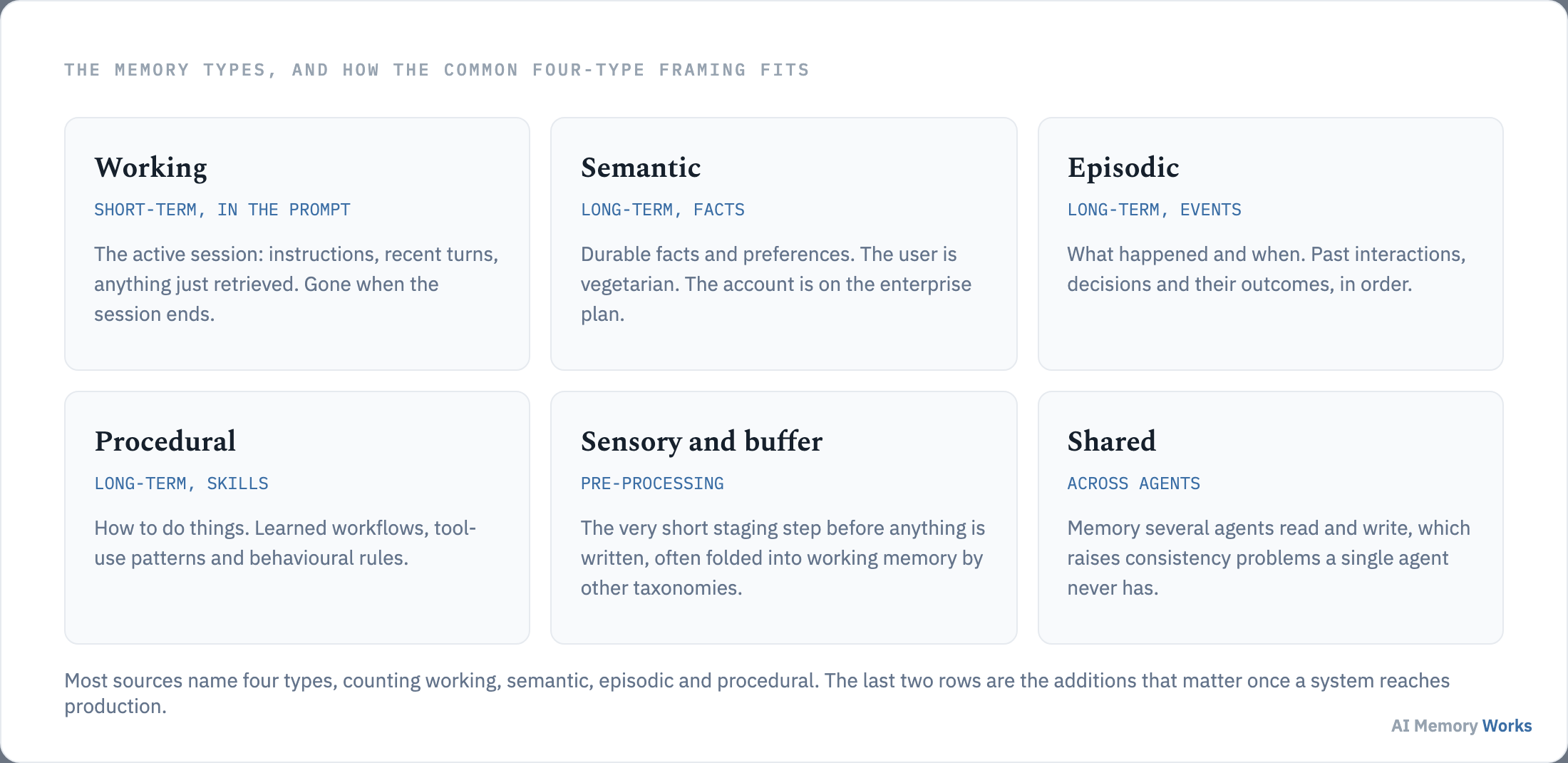
Recognition comes from semantic memory: durable facts and preferences about a person, retrieved when relevant. This is what makes an assistant feel like it knows someone, and it is the cheapest of the three to implement.
Continuity comes from episodic memory: an ordered record of what happened, so an agent can refer to a previous session accurately rather than approximately. This is what a support case or a long-running project needs.
Improvement comes from procedural memory: rules and workflows learned from corrections and outcomes. It is the least often implemented and the one that turns an agent from consistent to genuinely better over time, covered on procedural memory in AI agents.
Working memory, the context window itself, underpins all three, because retrieved memories still have to arrive in the prompt to be used. The full taxonomy is on the types of AI agent memory.
Capability is one side of the decision. The other is what it costs: what memory costs to add.
The economics
What does adding memory cost?
A search on every turn, a store to operate, a write path to maintain, and a new class of bug where the agent is confidently wrong about something that changed. Against that, it is usually cheaper than the alternative it replaces.
The alternative is resending the conversation, and its cost grows with every turn because the whole transcript is re-billed each time. Selective retrieval sends a roughly constant amount instead: Mem0 reports about 1,800 tokens per query against 26,000 for a full-context baseline, with p95 latency of 1.44 seconds against 17.1 seconds, a reduction of roughly 91% (Chhikara et al., 2025).
The accuracy side deserves stating honestly rather than omitting. On the LOCOMO benchmark, that same memory system scores 66.9 on the judge metric against 72.9 for the full-context baseline. Memory trades a small amount of accuracy for a large amount of cost and latency, and it becomes the only option once the conversation exceeds the window entirely.
The engineering cost is the part teams underestimate. Extraction has to be tuned, deduplication has to catch paraphrases, scope has to be enforced at query time, and consolidation has to run or the store degrades over months. Each is small; together they are a component with an owner, described on how to add memory to an AI agent.
Cost and capability are abstract until you see the same interaction both ways: what an agent with memory is like to use.
The difference in practice
What does an agent with memory actually feel like?
The difference is not that answers become cleverer, it is that the conversation stops restarting. Users rarely describe memory as a feature; they describe its absence as the assistant not listening.
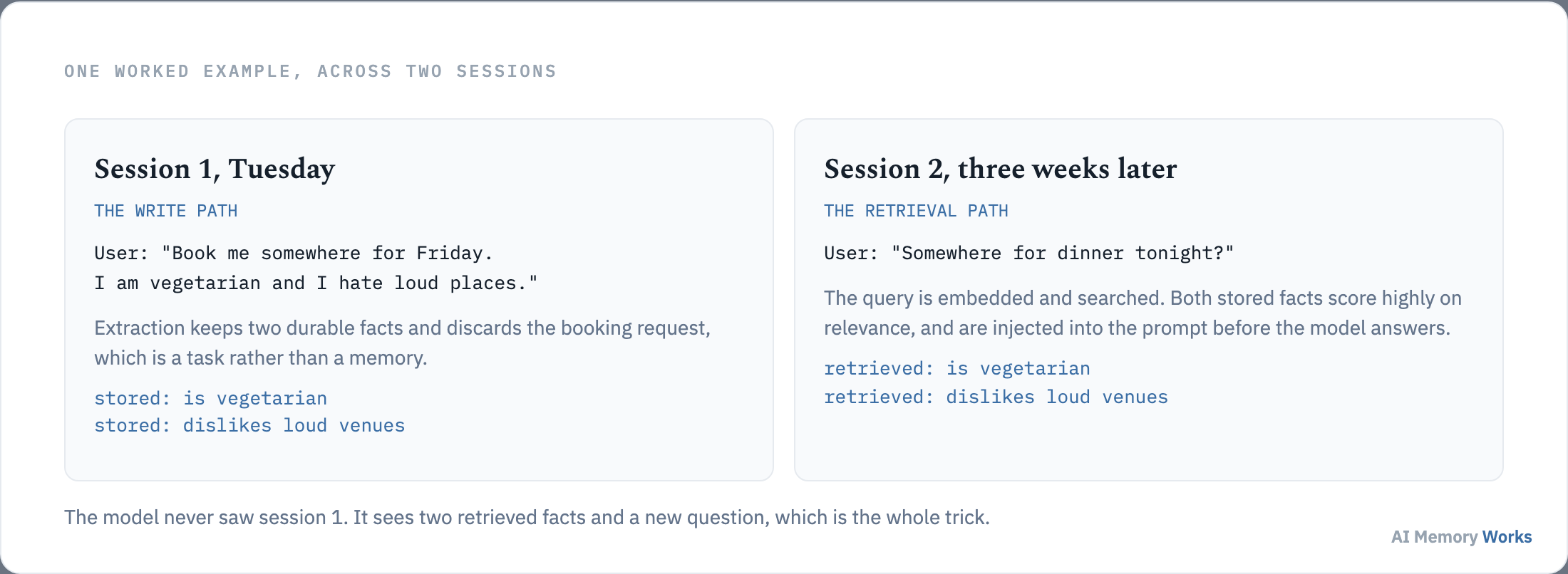
Take a support example. Without memory: a customer explains their setup, gets help, returns a week later with a follow-up, and explains the same setup again to an assistant that has no idea they have met. With memory: the follow-up starts from what was already established, and the assistant can say what was tried last time and whether it worked.
The same difference in a coding agent is starker still, because the context is not a preference but a convention. Without memory, an agent proposes a pattern the team rejected last month, every month. With procedural memory, the rejection is stored the first time and the pattern stops coming back.
There is a failure mode on the other side worth designing against. An agent that remembers too eagerly becomes unsettling: surfacing an offhand remark from six weeks ago is technically impressive and socially odd. Extraction that keeps only durable facts, and retrieval that injects only a few, is as much a product decision as an engineering one, covered on how agents write and store memories.
Which is exactly why the decision deserves a genuine test rather than a default: when an agent is better without memory.
The other answer
When is an agent better off without memory?
Whenever the task completes inside one request and nothing needs to survive it. Classification, extraction, translation, summarising a supplied document and most single-shot tool calls are all better stateless, and adding memory to them buys nothing while adding cost and failure modes.
Statelessness also carries properties that are easy to undervalue. A stateless agent is trivially scalable, reproducible because the same input produces the same behaviour, easy to test since there is no accumulated history to construct, and carries no data-retention obligation because it stores nothing about anyone. That last point is not minor: the moment a system remembers people, it acquires deletion and disclosure duties it did not have before.
The honest test is a single question: what specifically must survive the end of the session? If the answer is a concrete list, memory is justified and that list is your specification. If the answer is “context” or “the conversation”, the requirement has not been thought through, and building against it produces a store full of transcript that retrieves badly.
A sensible progression is to start inside the context window while conversations are short, and add memory when a specific failure from the list above starts appearing in real usage. Building it in anticipation is how simple products acquire a component nobody maintains.
Rather than argue it in the abstract, it can be tested: how to tell whether your agent needs memory.
The test
How do you test whether your agent needs memory?
Take real conversations and count how many turns would have been answered better if the system had known something from an earlier session. That number, rather than an opinion about the roadmap, is the case for or against building memory.
The method is deliberately unsophisticated. Sample fifty or a hundred real exchanges. For each one, ask whether the answer would have changed had the system known a fact stated previously. Sort the hits into categories: preferences, facts about the user’s situation, prior decisions, previous attempts. The distribution tells you not only whether you need memory but which type, because preferences point at semantic memory and previous attempts point at procedural.
Two signals commonly appear in that sample and are worth watching for. Users restating things is the clearest, since a person explaining their setup for the third time is doing the work your system should be doing. Contradictions across sessions are the second, where the assistant confidently asserts something incompatible with a previous exchange, which users read as unreliability rather than as forgetting.
If the count comes back low, the honest conclusion is that memory is not the highest-value thing to build, and that conclusion saves a component nobody would have maintained. If it comes back high, the same sample becomes the evaluation set for the build: those exact questions, checked for whether the right memory was retrieved and whether the answer used it, which is the measurement described in how to add memory to an AI agent.
Where memory is justified, the next question is which kind and how much, which is the subject of the types of AI agent memory and the best AI memory tools.
Agentic work
Does agentic AI need more memory than a chatbot?
Yes, and of a different kind. A chatbot mostly needs to remember facts about a person. An agent doing multi-step work with tools needs to remember what it already tried, what worked, and what the environment looked like when it did.
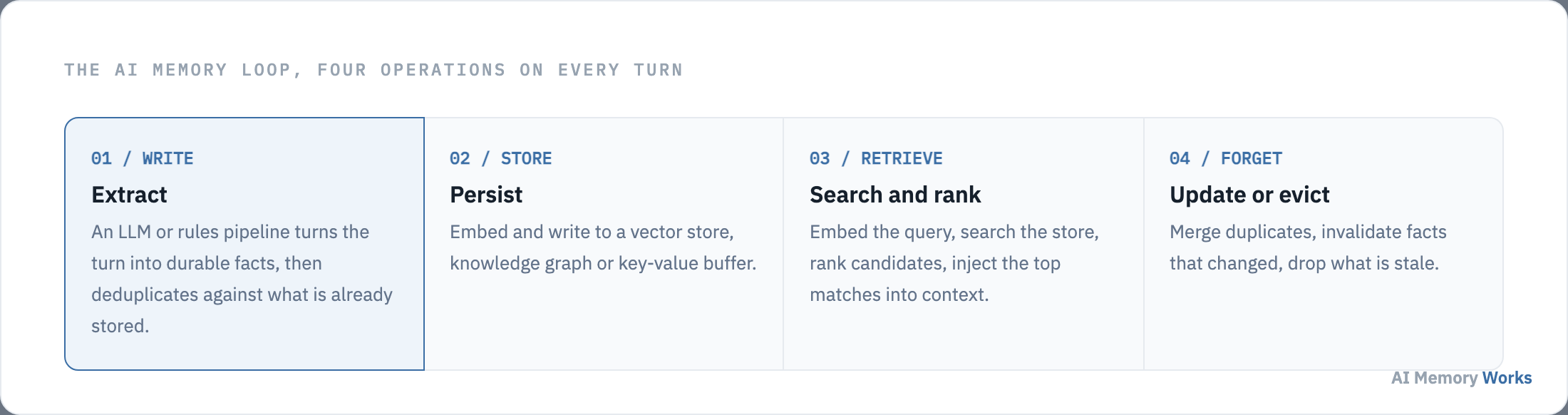
The difference is in the write path. A chatbot writes when a user states something durable, which is occasionally. An agent writes after actions: this tool returned that, this approach failed, this sequence worked. The volume is higher, the content is more structured, and much of it is procedural rather than factual.
The consequence is that agentic systems hit the maintenance problems sooner. A store accumulating outcomes from every step of every run grows quickly, and without consolidation and eviction it degrades within weeks rather than months. That is covered on memory consolidation and forgetting and eviction.
Long-running agents also hit the context window sooner, which is why paging designs originated in that setting, described on virtual context and MemGPT. The wider architecture question is covered on agentic application architecture.
One further difference is worth planning for. A conversational assistant’s memories are mostly about a person and stay relevant for a long time. An agent’s memories are mostly about a task and a system state, and both change quickly: a file that was refactored, an API that returned something different, an approach that worked before a dependency changed. Agentic memory therefore ages faster and needs a shorter retention policy than the equivalent chat product, which is a distinction almost no framework makes for you.
The practical upshot for planning is that agentic memory is usually a larger engineering commitment than a chat product’s, and it is often mistaken for the same job because both are called memory. Budget for the write volume and the shorter retention, not just for the store.
The mechanism that delivers all of this is the same in every case, and it is walked step by step in how AI memory works.
FAQ
Frequently asked questions
The questions that follow: whether memory makes agents smarter, and how much it slows them down.
Why can't LLMs remember on their own?
LLM APIs are stateless — each call starts without prior session context unless you resend it or add external memory. Model weights don't update per conversation. See stateless vs stateful LLMs.
Is ChatGPT memory the same as agent memory?
ChatGPT's built-in memory is a product feature for that app. Custom agents need their own memory layer — Engram, Mem0, Zep, LangMem or DIY stores. See how AI memory works.
What is the difference between stateless and stateful agents?
Stateless agents rely on the prompt only — no persistence across sessions. Stateful agents read and write to external memory stores. See stateless vs stateful LLMs.
Is agent memory the same as RAG?
No. RAG retrieves static documents; agent memory is dynamic and personal — updated across sessions. See memory vs RAG.
Do I need memory if I use Claude?
Claude's API is stateless for custom agents. Product memory features don't replace your own memory layer for apps you build. See add memory guide.
What is the best memory framework for agents?
Depends on stack: Engram for Weaviate stacks, Mem0 for managed API, Zep for temporal graphs, Letta for paging, LangMem for LangGraph. See best AI memory tools.
How do I add memory to an n8n AI agent?
Wire Engram, Mem0 or Zep API nodes for write after each turn and retrieve before each response. Same pattern as any framework. See add memory to an agent.
Should I use memory or fine-tuning?
Memory for dynamic per-user facts; fine-tuning for static domain style and knowledge. Most agents use both. See memory vs fine-tuning.
How do I test if my agent memory works?
Run LOCOMO and LongMemEval on your domain queries, plus track recall hit rate from production logs. See evaluation hub.
How do I integrate CRM data into agent memory?
Sync CRM fields to your memory store on user login or via webhooks — treat CRM as a seed for user profile memory. See build long-term memory.