Foundations · Comparison
AI Memory vs Human Memory
An agent’s memory is a database it searches; a person’s memory is a network that reconstructs an episode from a fragment. The field borrowed its entire vocabulary from human memory research, which is useful as a checklist of what a system needs and misleading as a description of how any of it works. This page separates the two, because the borrowed model quietly produces bad engineering decisions.
Three differences
The difference
How is AI memory different from human memory?
In where the memory sits, in what retrieval does, and in whether anything happens without being told to. An agent’s memories are rows in a store outside the model, retrieved by search and read as text. A person’s memories are not separable from the network that produces them and are not read at all.
Everything else on this page follows from that. Because an agent’s memory is a database, it is exact, complete, permanent and inspectable by default. Because a person’s memory is a reconstruction, it is approximate, partial, fading and altered by use. Neither set of properties is better; they are the strengths and failures of different machines.
The comparison matters commercially because users arrive with the second model and meet the first. An agent that recites something a user said eleven months ago, word for word, in an unrelated conversation, has behaved correctly and feels wrong, and no amount of retrieval tuning fixes a mismatch of expectation.
The first thing to understand is why the borrowed language is everywhere in the first place: why AI memory systems borrow human memory terms.
The borrowed words
Why do AI memory systems borrow human memory terms?
Because the categories are genuinely useful and nobody has produced better ones. Episodic, semantic, procedural and working memory come from twentieth century psychology, and they survive in agent engineering because they name distinctions a builder actually has to make.
The distinction between a fact about a user and a record of an interaction is real, and it changes how each is written, retrieved and expired. The distinction between knowing something and knowing how to do something is real too, and it decides whether a lesson belongs in a store or in an instruction. The vocabulary earns its place by naming those choices, and the types themselves are covered on the types of AI agent memory.
What the vocabulary does not do is describe a shared mechanism. Calling a table of past interactions episodic memory says what the rows are for, not that anything hippocampal is occurring. The borrowing is a naming convention, and treating it as a claim about implementation is the source of most of the trouble in this comparison.
The clearest place to see the gap is in the word both fields use for the central operation: whether an agent recalls the way a person does.
Mechanism
Does an AI agent recall the way a person does?
No, and the difference is not one of degree. Human recall completes a whole memory from a partial cue inside the same network that stores it. Agent retrieval turns a message into a query, fetches matching statements from a database, and places them into a prompt as text.
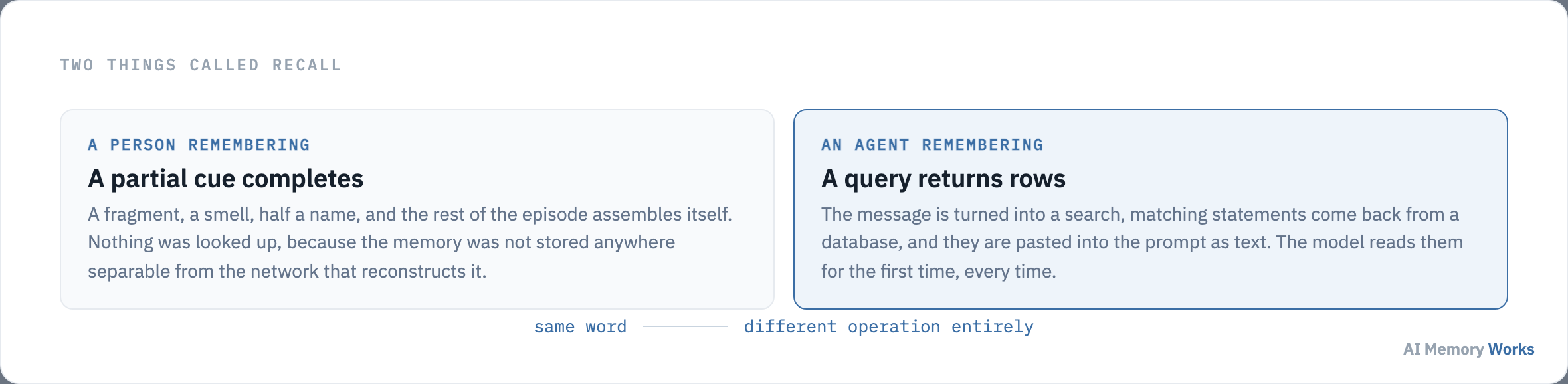
The neuroscience is more specific than the analogy suggests. Research comparing the two directly, published in Heliyon by Edmund Rolls in 2024, argues that when the hippocampal system generates a complete memory from an incomplete retrieval cue, both what the brain computes and how it computes it differ fundamentally from what generative models do, with local associative learning rules on one side and non-local error backpropagation on the other.
For a builder the consequence is practical rather than philosophical. There is no pattern completion in your system. If a memory was not written, no cue will reconstruct it; if it was written badly, no amount of context will repair it. Everything an agent appears to remember was put in the prompt by a retrieval step you control, which is why the read path is worth understanding precisely, on how agents retrieve memories.
That difference in mechanism produces a difference in behaviour that surprises people more than any other: how forgetting differs.
Forgetting
How is forgetting different?
People forget automatically and agents forget nothing at all unless somebody builds it. This is the single most consequential difference in the comparison, and it runs opposite to the direction most people expect.
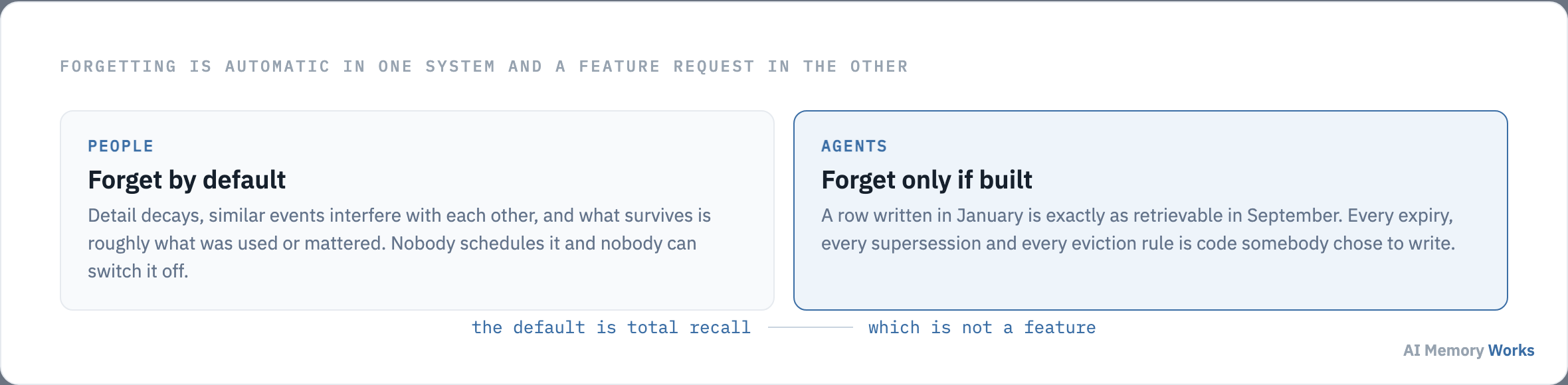
Human forgetting is not a defect the brain would remove given the chance. Detail fades, similar episodes blur together, and what survives is roughly what was used or what mattered, which keeps recall relevant as a life accumulates. A person who remembered every meal in equal detail would be worse at remembering, not better.
A memory store has the opposite default. A row written in January is exactly as retrievable in September, with the same confidence, in the same present tense, regardless of whether it is still true. Nothing decays, nothing blurs and nothing yields to a newer fact unless a supersession rule says so.
So forgetting becomes engineering: expiry on things that were true of a moment, supersession when a fact changes, and eviction when the store grows past what retrieval can serve well. That work is covered on forgetting and eviction and conflicting memories. Systems that skip it do not get a better memory; they get one that is confidently out of date.
There is a second human property teams try to import, and this one turns out to have an agent analogue after all, in an unexpected place: whether AI memory is reconstructive.
Distortion
Is AI memory reconstructive the way human memory is?
Not on the read path, and dangerously so on the write path. Retrieving a row changes nothing about it. Writing a row from a model’s own output is where an agent acquires the machine equivalent of a false memory.
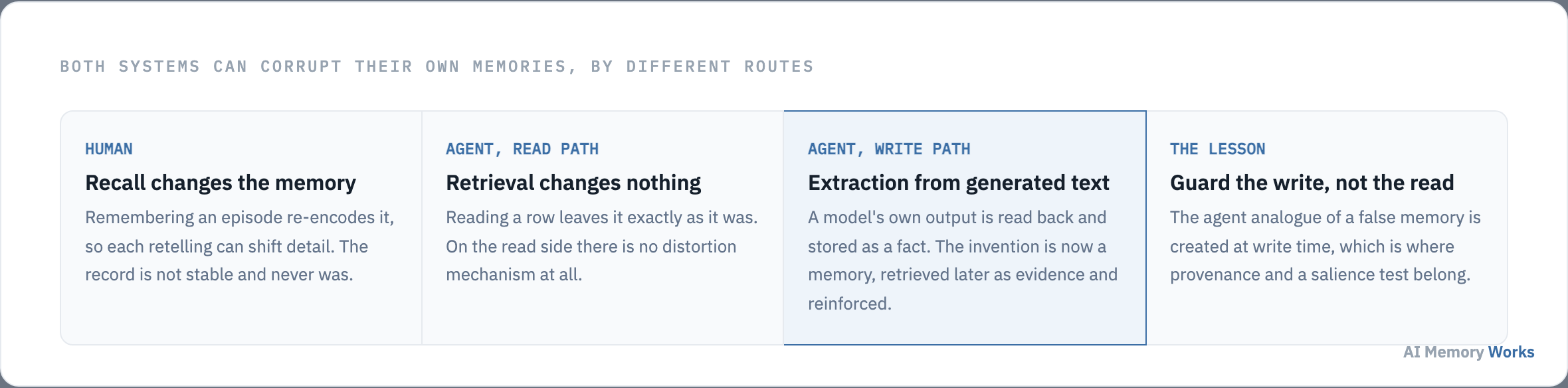
In people, remembering an episode re-encodes it, so each retelling can shift a detail, and a confidently held memory can be substantially wrong. This is well established and it is the property most often invoked when someone argues that agent memory is human-like.
The read path in an agent has no such mechanism. A row is bytes; reading it a hundred times leaves it identical. If an agent’s account of something drifts between conversations, the cause is different retrieval on each occasion rather than a memory that changed.
The write path is the real analogue, and it is worse than the human version because it compounds silently. A model states something plausible that was never said, the extraction step reads its own output and stores it as a fact, and the fact is retrieved months later as evidence for the same claim. Nothing distinguishes it from a memory of something the user actually said. The countermeasures are provenance on every memory and extraction from user turns rather than from generated text, covered on how agents write and store memories.
Distortion aside, the two systems also fail at their limits in completely different ways: what limits each one.
Limits
What limits each one?
Human memory degrades gradually and an agent’s fails at a boundary. The shape of the failure matters more than the size of the capacity, because a gradual limit can be lived with and a hard one has to be designed around.
An agent has two limits and they behave differently. The store is effectively unbounded, since adding rows is cheap, though quality falls as it grows because retrieval has more to sift. The context window is a hard ceiling: everything fits until nothing does, and what falls out is decided by whatever rule you wrote rather than by importance. That constraint is treated on memory versus the context window.
Human memory has no equivalent boundary. Recall gets less precise, older material becomes gist rather than detail, and retrieval competes with similar episodes, but nothing is dropped at a threshold. There is no moment where a person’s memory returns an error because a limit was exceeded.
On speed and fidelity, the comparison is lopsided and worth stating once. A store returns an exact string in milliseconds, which no person can do; a person retrieves an association across decades with no query, which no store can do. Designing an agent to imitate the second while giving up the first is a strange trade, and it is occasionally proposed.
All of which sets up the section that justifies the page: where the human analogy misleads engineers.
The warning
Where does the human analogy mislead engineers?
In four specific places, each of which produces a real design error. These are not philosophical objections; they are mistakes that appear in working systems and are traceable to the borrowed model.
Assuming decay happens. The human model says old memories fade, so nobody builds expiry, and the store fills with facts that were true once. A recency weight in the scoring function is not decay, because the memory is still there and still returned when nothing newer competes. The distinction is on memory scoring.
Assuming consolidation is automatic. People consolidate memories while asleep, so a system that is idle sounds like it should be doing the same. Nothing runs unless it is scheduled, and what to run is a design question, covered on memory consolidation and, as a deliberate idle-time pattern, on sleep-time compute.
Assuming an agent knows a memory is old. A person recalling a fact from years ago experiences it as distant and hedges accordingly. A retrieved row arrives with no such signal unless the timestamp was stored and something in the prompt uses it, so an eleven-month-old preference is stated with the confidence of this morning’s.
Assuming graceful degradation. Human recall gets vaguer under load. An agent’s context does not get vaguer; it truncates, and the material that falls out is whatever your assembly rule ranked last, which may well be the memory that mattered.
The pattern behind all four is the same: the human model describes emergent behaviour, and a memory system has no emergent behaviour, only code somebody wrote. Which leaves an obvious question, given that the vocabulary is still worth using: what the analogy is actually good for.
What to keep
What is the analogy actually useful for?
As a checklist of decisions, and as a description of what your users expect. Both are valuable and neither is an implementation guide.
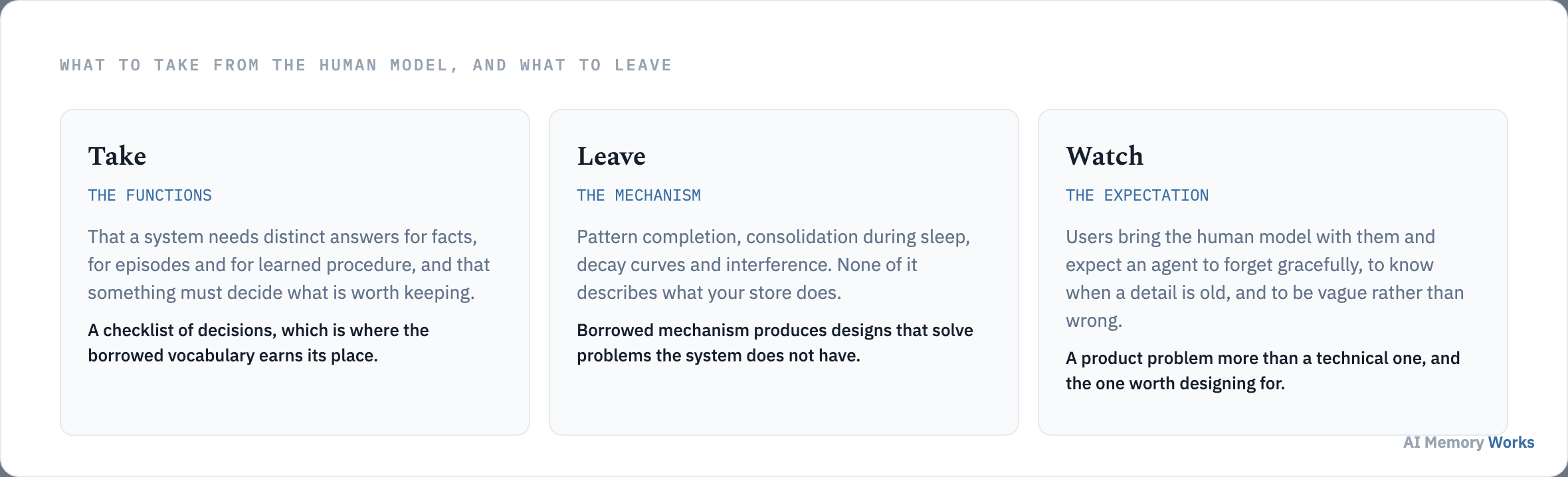
As a checklist it is genuinely good. Human memory research says a complete system needs somewhere for facts, somewhere for episodes, somewhere for learned procedure, a way of deciding what is worth keeping, and a way of letting go of the rest. Run your design against those five and the gaps show up immediately, which is more than most architecture reviews achieve.
As a description of user expectation it is better still, because it tells you what will feel wrong. Users expect an agent to hold the gist rather than the transcript, to treat old information as old, to stop mentioning something that stopped mattering, and to be vague rather than confidently outdated. None of that is how a database behaves, and all of it can be engineered deliberately once you know it is expected.
What to leave behind is the mechanism. Pattern completion, consolidation during sleep, decay curves and interference describe a machine you are not building, and borrowing them produces designs that solve problems your system does not have while ignoring the ones it does.
The video below is the walkthrough that ranks for this comparison, covering the borrowed categories from the engineering side.
If you are turning any of this into a design, the practical starting points are how AI memory works and building long-term memory for an agent.
FAQ
Frequently asked questions
The questions builders ask once the analogy stops being a metaphor and starts affecting decisions.
Do AI agents have episodic memory in the same sense people do?
They have a table of past interactions that plays the same role, which is what the term names. The mechanism has nothing in common: an agent's episodic memory is retrieved by search and read as text, while a person's is reconstructed inside the network that stores it.
Should an AI agent be designed to forget like a human?
It should be designed to forget deliberately, which is not the same thing. Copy the outcome, that stale and unused information stops surfacing, without copying the mechanism, because decay curves are a poor fit for facts that are either still true or not.
Can an AI agent have false memories?
Yes, and they are created on the write path. If extraction runs over the model's own output, an invented detail becomes a stored fact, is retrieved later as evidence and is reinforced. Provenance on every memory is what makes this detectable.
Is a context window like human working memory?
It is the closest analogy in the comparison and still misleading. Both hold what is currently in play, but a window has a hard boundary and drops whatever your assembly rule ranked last, while working memory degrades gradually under load.
Does human memory research help when designing agent memory?
As a checklist of decisions, yes: what to store, how to separate facts from episodes from procedure, what is worth keeping and what to release. As a source of mechanisms to implement, no.
Why do users expect agents to remember like people?
Because conversation is the interface, and everything else that converses with them is human. That expectation is a product constraint rather than a technical one, and it is worth designing to explicitly: hold the gist, treat old facts as old, and stop volunteering what stopped mattering.