Compare · Deployment
Open-Source vs Managed AI Memory
Open-source AI memory gives you control, self-hosting and customization; managed AI memory gives you faster time-to-market, hosted extraction pipelines and less ops, and the right choice depends on compliance, team size and architecture fit.
Open source
Self-host, full control, you operate
Managed
Hosted API, fast POC, vendor SLA
Open source
What does open-source AI memory mean?
You run the memory stack on your infrastructure: SDK, extraction, vector or graph store and retrieval.
Examples: self-hosted Weaviate + Engram, Mem0 OSS, Letta OSS, Graphiti (Zep’s OSS graph engine), LangMem, Redis DIY. You own data residency, schema, scaling and the security boundary.
Managed
What does managed AI memory mean?
A vendor hosts extraction, the storage API, scaling and updates; you trade control for speed.
Examples: Engram on Weaviate Cloud, Mem0 Cloud, Zep Cloud, Supermemory API. Managed is not “less production”; fit matters. Many teams start managed and self-host later at scale.
Scope
Is this the same decision as self-hosting an LLM?
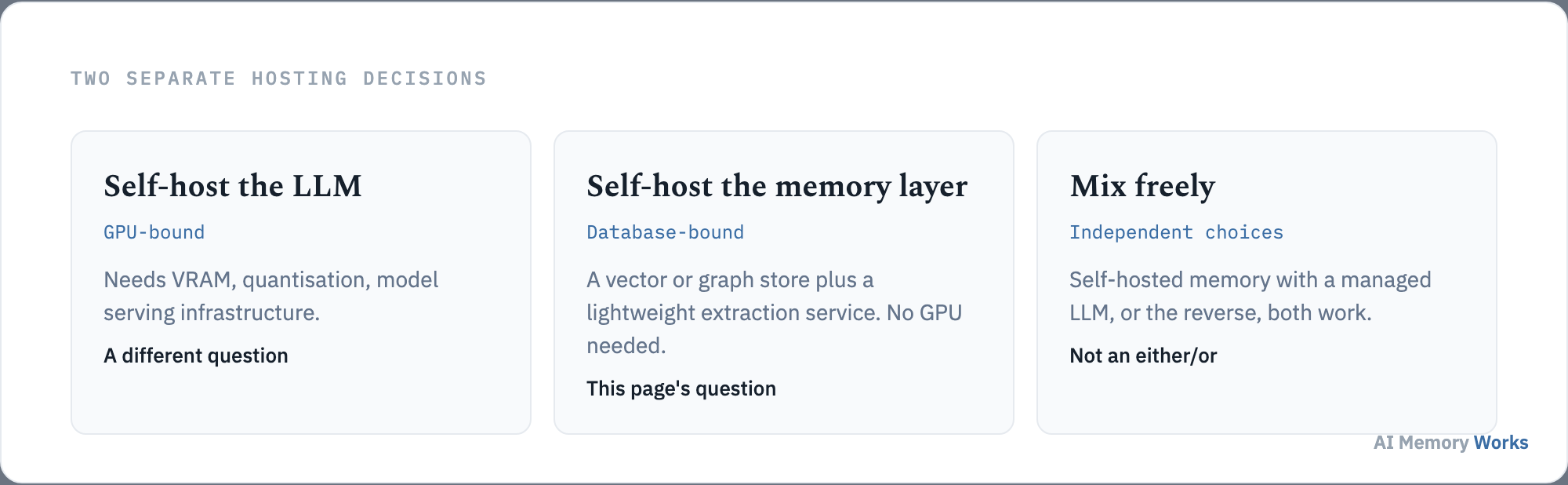
No, and most of what’s written about “self-hosted vs managed AI” is actually about the wrong layer.
Most public writing on self-hosted-vs-managed AI is about hosting the model itself: GPU provisioning, VRAM, quantisation, tokens per second. That’s a real and separate decision from hosting a memory layer, which is a vector or graph database plus a lightweight extraction service, with no GPU requirement at all. A team can self-host Engram on their own Weaviate cluster while still calling a managed LLM API for reasoning, or run an open-weight model on their own GPUs while using Mem0 Cloud for memory. Conflating the 2 decisions leads to importing GPU cost tables that simply don’t apply to what a memory layer actually runs on.
Comparison
How do open-source and managed memory compare, framework by framework?
Self-host complexity and OSS availability vary independently across the 6 frameworks teams actually compare.
| Framework | OSS | Managed | Self-host complexity | Time-to-POC |
|---|---|---|---|---|
| Engram (Weaviate) | Self-host Weaviate | Weaviate Cloud GA | Medium | Fast (managed) |
| Mem0 | Yes (GitHub) | Mem0 Cloud | Medium | Fastest |
| Zep | Graphiti OSS | Zep Cloud | High (graph) | Medium |
| Letta | Yes | Letta Cloud | Medium | Medium |
| LangMem | Yes | Bring your store | Medium | Medium |
| Cognee | Yes | Limited | High | Slower |
| Redis DIY | Yes | Redis Cloud | Low to high | DIY-dependent |
Economics
When does self-hosting actually save money?
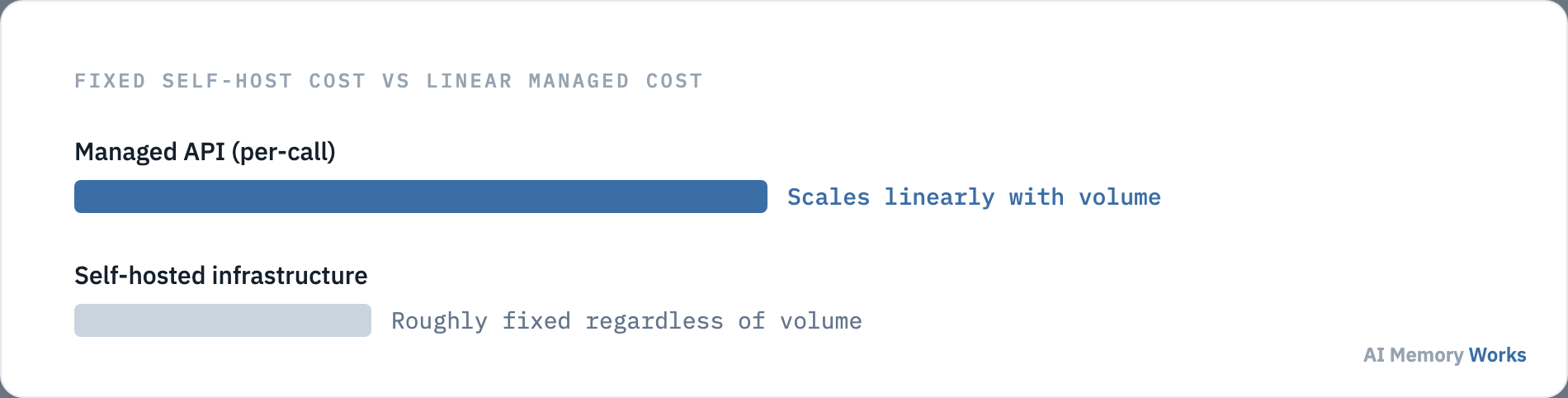
The same fixed-cost-vs-linear-cost pattern that governs LLM hosting applies to memory infrastructure, past a volume crossover point.
No public benchmark yet compares Engram’s or Mem0’s self-host cost against their managed cost at volume, so treat any specific dollar figure with caution. What is well documented, independently, in adjacent AI infrastructure decisions is the shape of the curve: a managed API charges per call or per token, so cost scales linearly with usage, while a self-hosted store runs on infrastructure whose cost stays roughly fixed regardless of query volume. 2 independent cost studies of LLM hosting (a different workload, but the same economic shape) put the crossover point for that workload between 100,000 and 300,000 requests a month, and separately around 500,000 tokens a day; below that line, the fixed cost of running your own infrastructure isn’t worth carrying, and above it, the linear-scaling managed cost starts to dominate. The same logic applies to a self-hosted vector or graph store: below some volume of memory writes and retrievals, the fixed cost of running Weaviate or Postgres yourself costs more than paying per-call; above it, the crossover reverses.
For a sense of scale on the LLM-hosting side of that comparison, since it’s the only side with public numbers: one study found a 10-developer team processing roughly 2 million tokens a day paid about $50 a month self-hosting a mid-sized open-weight model on a modest VPS, against roughly $600 a month for GPT-4o and roughly $540 for Claude Sonnet at the same volume. Another study, looking at a higher-volume workload, found cloud APIs costing roughly $625 to $900 a month at 50,000 requests, but a leased GPU for self-hosting holding flat at roughly $2,100 a month regardless of whether volume grew to 500,000 requests. Both studies land on the same shape from opposite directions: fixed self-hosted cost, linear managed cost, and a crossover somewhere in between. None of these figures are memory-layer numbers, and none should be quoted as if they were; they’re included here only to make the shape of the curve concrete rather than abstract.
Setup time follows a similar pattern to LLM hosting even though the infrastructure is different: getting started with a managed memory API is typically measured in minutes, an account, an API key, a first call. Self-hosting ranges from straightforward with some patience (a single-node Weaviate instance with Engram) to genuinely complex (a sharded graph store for Zep’s Graphiti at scale), and the complexity doesn’t end at launch: embedding-model version churn, schema migrations and store operations all become the self-hosting team’s ongoing responsibility rather than a vendor’s.
The maintenance burden compounds in ways that are easy to underestimate from a demo. A managed vendor absorbs embedding-model upgrades transparently; a self-hosted deployment has to decide when to re-embed an existing store against a newer model, and re-embedding at scale is itself a migration project, not a config flag. Vector index rebalancing, backup and restore drills, and access-control changes as the team grows all land on whoever owns the self-hosted store, which is precisely why the “team ops capacity” row in the framework below tends to be the deciding factor more often than raw cost.
Decision framework
How do you decide between open-source and managed memory?
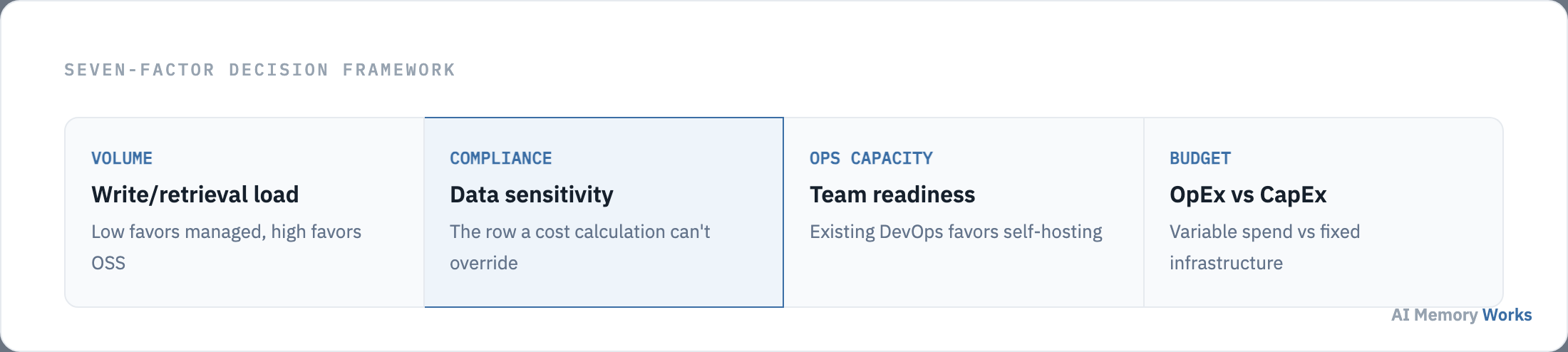
Seven factors, adapted from how AI infrastructure teams generally frame the cloud-vs-self-hosted decision.
| Factor | Choose managed | Choose open-source |
|---|---|---|
| Write/retrieval volume | Low or unpredictable | High and steady, past the crossover point |
| Data sensitivity | Standard | Regulated (GDPR, HIPAA, SOC 2), data residency required |
| Team ops capacity | Small team, no dedicated infra role | Existing DevOps or data-infra capacity |
| Budget model | Variable, pay-as-you-go | Fixed, predictable infrastructure spend |
| Customization needs | Standard extraction and retrieval logic is enough | Custom extraction, invalidation or scoring logic required |
| Existing infra | None to reuse | Vector or graph store already running in-house |
The data-sensitivity row carries the most weight for regulated teams specifically because it’s the one factor a cost calculation can’t override. GDPR, HIPAA and SOC 2 all impose real restrictions on where personal or health data can be processed and stored; a managed memory API that stores extracted facts on a vendor’s infrastructure is, for many organizations, a compliance question before it’s ever a cost question. Self-hosting keeps that data inside a network the organization already controls and audits, which simplifies the compliance conversation even when it doesn’t simplify the engineering one. Landing in different columns for different rows is normal; that’s exactly what the hybrid pattern below is for.
Hybrid
Can you combine managed and self-hosted memory?
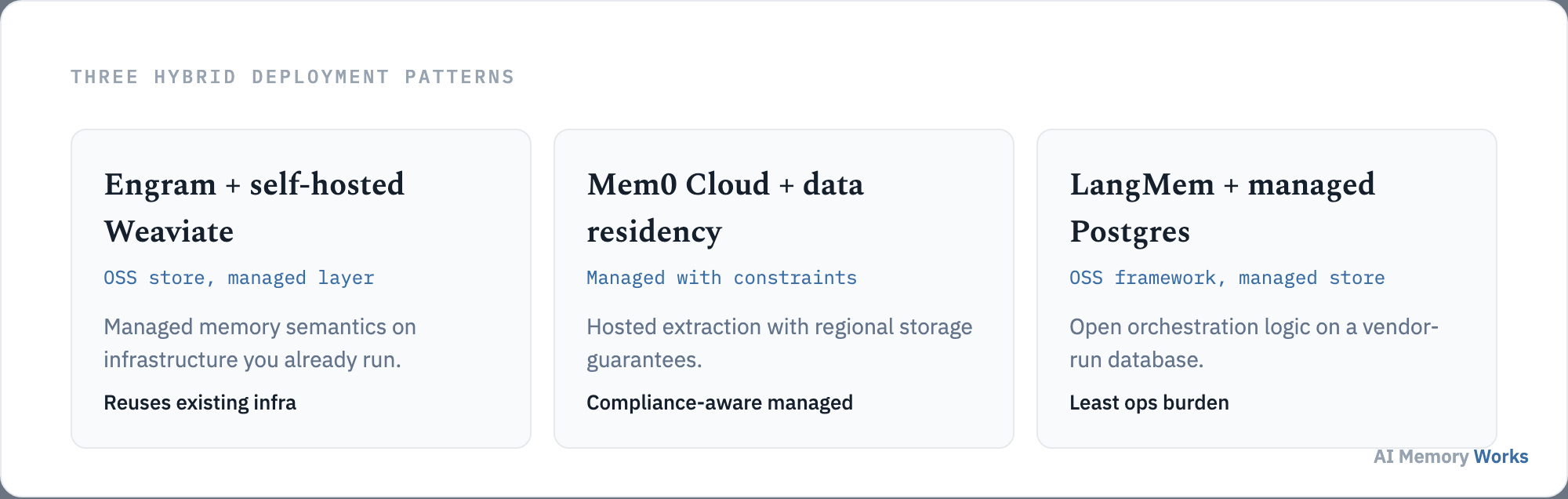
Many teams combine both: managed extraction with a self-hosted store, or an OSS framework on a managed vector database.
Pattern examples: Engram on self-hosted Weaviate; Mem0 Cloud with data residency options; LangMem OSS with a managed Postgres vector store. The trade-off is consistent across all 3: more integration work in exchange for more control over the specific piece that matters most to your compliance or cost picture, while leaving the rest to a vendor. This is usually the right default when a team’s answer to the decision framework above isn’t uniform, which, in practice, is most teams: compliance may demand self-hosted storage while the extraction pipeline itself carries no sensitive-data risk and is better left to a vendor who maintains it full-time.
Migration
How do you migrate between open-source and managed?
The direction rarely matters as much as the sequence: export, remap, re-embed, dual-write, then validate before cutting over.
- Export memories via API
- Map schema to the target deployment
- Re-embed if embedding models differ
- Dual-write during cutover
- Validate LOCOMO recall@k before switching traffic
→ Conflicting memories (data integrity)
FAQ
Frequently asked questions
The framework-by-framework choice, the real economics, and how to migrate between the two.
Is Mem0 open source?
Yes. Mem0 offers OSS on GitHub plus Mem0 Cloud managed API. LOCOMO J 66.9 (Chhikara et al., 2025). Compare Engram for Weaviate-native managed memory.
Can you self-host Zep?
Graphiti (Zep's graph engine) is open source. Zep offers managed cloud and self-hosted deployment options. See Zep alternatives.
Letta OSS vs cloud?
Letta offers both open-source self-host and Letta Cloud. MemGPT DMR 93.4% (Packer et al., 2023). Choose based on ops capacity.
Is Engram only on Weaviate Cloud?
Engram GA on Weaviate Cloud (June 2026). Weaviate itself can be self-hosted; Engram integrates with your Weaviate deployment. See Engram explained.
Redis vs a managed memory API?
Redis is a DIY sub-ms buffer, you build the pipeline yourself. Managed APIs (Engram, Mem0) ship extraction plus retrieval. Often paired: Redis for short-term memory, a managed API for long-term memory.
Is open source cheaper at scale?
Often yes past a volume crossover point, since you pay infrastructure and engineering time rather than per-call fees. Below that crossover, managed POC speed wins. No public benchmark yet compares Engram's or Mem0's own self-host cost against their managed cost at volume.
Is managed memory GDPR-compliant?
Depends on the vendor; check data residency, delete APIs and the DPA. Self-hosting gives full control for erasure requests. See memory management.
Can LangMem be self-hosted?
Yes. LangMem is OSS. You configure the LangGraph store backend (Postgres, Redis, custom vector DB).
Best open-source memory stack in 2026?
Depends on architecture: Engram on Weaviate (vectors), Graphiti for Zep (temporal graph), Mem0 OSS (API), Letta (paging), LangMem (LangGraph), Redis DIY (buffers).
Is a hybrid open-source plus managed pattern recommended?
Yes, for many teams: managed extraction with a self-hosted store, or an OSS framework on a managed vector database. Validate with LOCOMO before cutover.
Is self-hosting a memory layer the same as self-hosting an LLM?
No. Self-hosting an LLM needs GPU provisioning and VRAM; self-hosting a memory layer needs a vector or graph database and a lightweight extraction service, with no GPU requirement.
What happens when the embedding model changes on a self-hosted memory store?
You have to decide whether to re-embed the existing store against the newer model. At scale, re-embedding is a migration project, not a config flag; a managed vendor absorbs this transparently instead.
Does compliance always mean self-hosting?
Not necessarily, but it's the row in the decision framework a cost calculation can't override. GDPR, HIPAA and SOC 2 restrict where personal or health data can be processed; some managed vendors offer data residency options that satisfy this without full self-hosting.